
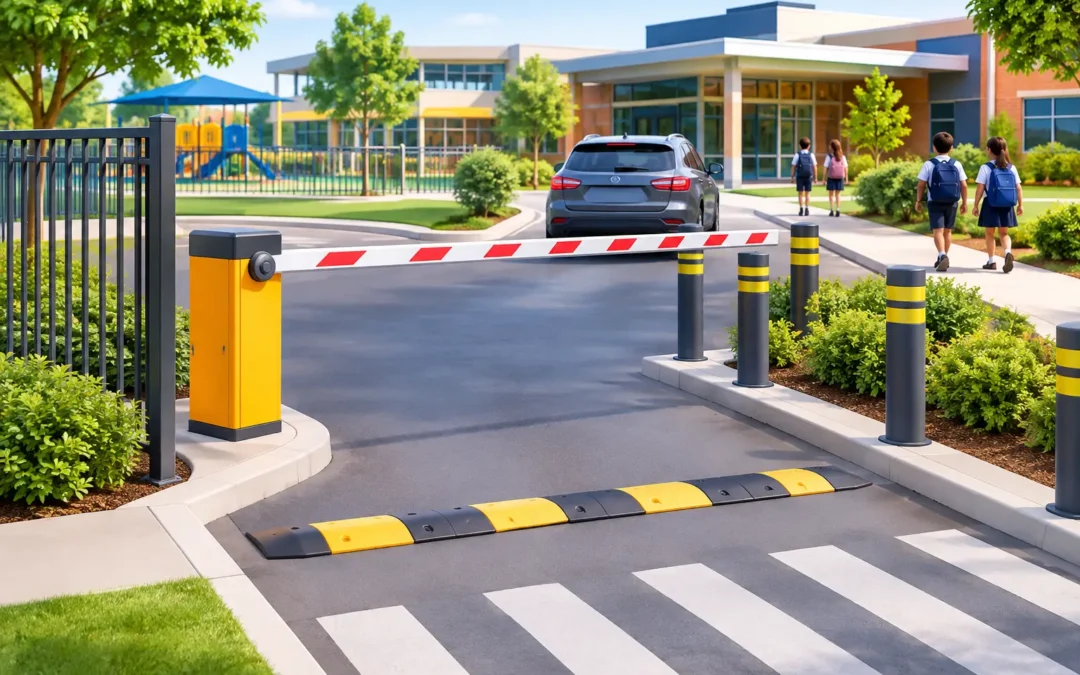
The best barriers for school driveways do more than stop a vehicle. They separate children from traffic at the busiest and least predictable parts of the day: morning drop-off, afternoon collection, excursions, deliveries and sporting events. A suitable system needs to control where vehicles travel, give staff clear visibility and remain practical for authorised access.
For Melbourne schools, the right answer is rarely a single product. Driveway width, pedestrian routes, emergency access, bus movements, visitor parking and the age of students all affect the specification. The most effective projects combine gates, bollards and fencing into a layout that works every school day, not just on a site plan.
What the best barriers for school driveways need to achieve
A school driveway barrier should create a clear physical boundary between vehicles and people without making the entrance difficult to manage. It needs to withstand regular use, discourage unauthorised vehicle access and avoid introducing pinch points where students gather.
Start by mapping what happens at the gate line and beyond it. Consider the arrival route, the pedestrian crossing point, the turning area, the staff car park, the delivery zone and the nearest building entrance. A barrier that protects one location can create a problem elsewhere if it forces cars to reverse across a footpath or leaves pedestrians walking through a vehicle queue.
The best layout gives drivers obvious direction. It also gives office staff and crossing supervisors a manageable way to close off access when required. This is why purpose-built gates and bollards generally perform better than temporary cones, portable signs or improvised chains.
Emergency access cannot be an afterthought
Fire appliances, ambulances, maintenance contractors and school buses may all need access at different times. Fixed barriers are effective where a route should never be used by vehicles, but they are not appropriate across a required emergency path.
Where occasional vehicle access is necessary, removable bollards or lockable gates can provide a controlled solution. The operating process matters as much as the hardware. Staff should be able to identify the key, lock, remote or release procedure quickly, including outside normal office hours.
Before installation, confirm the school’s emergency management requirements, relevant authority conditions and access dimensions. A site-specific review is essential, particularly where the driveway is shared with community users or sporting facilities.
Fixed bollards for permanent protection
Fixed steel bollards are among the most reliable ways to protect a pedestrian area, building frontage, gate control point or walkway entrance. Installed at the right spacing, they prevent vehicles from mounting kerbs or entering a restricted zone while allowing people, wheelchairs and prams to pass through.
They suit locations where vehicle access is never required, such as along a pedestrian approach, beside administration buildings or at the edge of a playground-facing driveway. Bollards can also be used to reinforce a fence line where cars may otherwise cut across landscaping or open ground.
The trade-off is permanence. Once fixed bollards are installed, changing traffic arrangements can be difficult. Their position must therefore account for vehicle turning circles, accessible paths, drainage, gate swing and maintenance equipment. Visibility is also critical. A contrasting finish, appropriate reflectors or nearby line marking may be needed so drivers can see the barrier in poor light or wet weather.
Removable bollards where access changes
Removable bollards are a strong option for school driveways that operate differently during the day. They can close a vehicle route at drop-off and pick-up times, then be removed for deliveries, events or grounds maintenance.
This flexibility makes them useful near courts, assembly areas, service lanes and shared pedestrian zones. A properly designed socket system keeps the bollard secure when in place and reduces the temptation for unauthorised removal. When removed, the ground socket should be covered neatly to avoid creating a trip hazard.
Their main limitation is operational discipline. Someone needs to store the bollard, control access to the key and reinstall it correctly. For a busy school, it is worth nominating responsibility rather than relying on an informal arrangement between staff members.
Sliding and swing gates for controlled entry
Gates are usually the centrepiece of driveway control. A lockable manual gate may be sufficient for a low-traffic staff entrance, while a higher-volume main entry may need an automated sliding gate with an access-control system.
Sliding gates are often preferred where space behind the gate is limited or where a swing gate would move into a pedestrian route. They can provide a wide clear opening for buses, service vehicles and emergency access, provided there is enough run-back space along the fence line. They also work well with tubular steel or welded mesh fencing, giving the driveway a consistent and secure perimeter.
Swing gates remain practical on many school sites, particularly for secondary entrances and wider setbacks. They require room to open safely and should never obstruct a public footpath, internal crossing or vehicle lane. Bi-folding or cantilevered arrangements may suit constrained sites, but these need careful engineering and installation.
Automated gates add convenience, but they also need a clear maintenance plan. Safety devices, controls, hinges, tracks and locking hardware should be checked routinely. The gate should not be treated as a substitute for supervision during peak pedestrian periods. At many schools, the safest arrangement is to hold the gate open during a managed arrival window and close or secure it outside those times.
Pedestrian gates and fencing complete the barrier line
A driveway gate alone will not keep students out of vehicle areas if there is an easy gap beside it. Pedestrian gates and perimeter fencing should guide people towards a deliberate crossing point rather than leave several informal paths across the driveway.
Tubular fencing is a common choice around school entrances because it is durable, visible and difficult to climb compared with some lighter fencing options. Welded mesh can also provide strong perimeter definition while maintaining sightlines for staff. The best material depends on the level of security required, the appearance of the school frontage and the need to match existing fencing.
Pedestrian gates need reliable self-closing and self-latching hardware where access must be controlled. Gate placement should support natural movement to reception, car parks and school paths. If families regularly push prams or mobility aids through the entrance, the clear opening and surface finish deserve close attention.
Designing for drop-off and pick-up traffic
The busiest fifteen minutes of the day can expose weaknesses in an otherwise sound driveway design. Parents may stop where they should not, perform three-point turns or queue back towards the road. Barriers cannot solve every behaviour issue, but they can make the preferred movement obvious and prevent the most unsafe shortcuts.
Use fencing and bollards to channel pedestrians to the designated crossing point. Keep gate controls away from areas where children wait. Avoid locating removable barriers where staff must stand in live traffic to operate them. Where a delivery vehicle uses the same driveway as families, schedule access outside peak periods wherever possible.
Sightlines matter. A solid barrier may be appropriate for security, but it can hide a child from a driver turning out of the site. Open-style fencing and carefully positioned gates often provide a better balance at driveway edges. Landscaping, signs and parked vehicles should also be considered, as they can reduce visibility even when the barrier layout is sound.
Choosing a barrier system that lasts
School barrier systems are exposed to daily impacts, wet weather, cleaning equipment and frequent gate cycles. Specify materials and finishes that suit the environment, particularly in coastal Melbourne and Mornington Peninsula locations where corrosion resistance is a practical consideration.
Installation quality is equally important. Posts, footings, hinges, track alignment and bollard foundations need to suit the ground conditions and expected use. A gate that drags, a bollard that loosens or a latch that fails will quickly become a safety and maintenance issue.
Ask your fencing contractor to assess the full access arrangement rather than quoting only on a gate or bollard count. The right contractor will identify conflicts with existing paths, fence lines, drainage, services and vehicle movements before work starts. Materials and installation should be selected with relevant Australian Standards and the site’s particular requirements in mind.
For schools across Melbourne and the Mornington Peninsula, Minster Fencing can inspect the site and provide an obligation-free quote for driveway gates, fixed or removable bollards, tubular fencing and welded mesh systems. With more than 40 years of fencing experience, the team can help turn a busy entrance into a clearer, more controlled access point.
A well-planned driveway barrier should feel ordinary once it is in place. Parents know where to queue, students know where to walk, staff can manage access confidently, and the school day begins with fewer avoidable risks.