
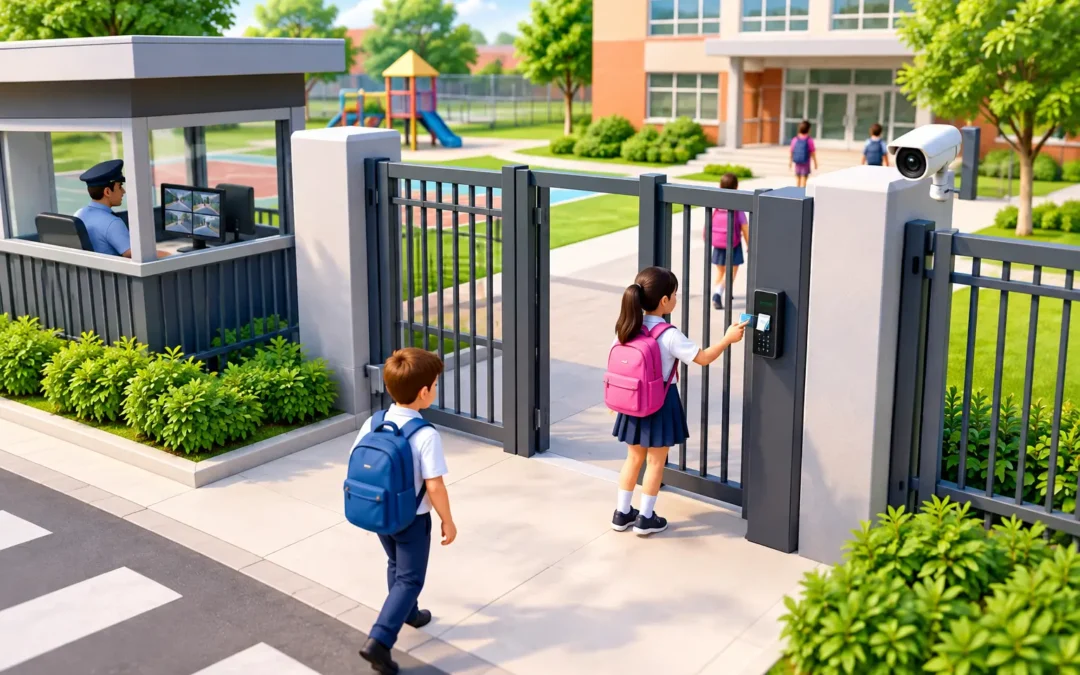
A school gate has to do more than stop unwanted entry. It needs to direct students, staff, parents, visitors and contractors through the right access points without creating delays at drop-off, pick-up or an emergency evacuation. Knowing how to secure school gates starts with treating the gate, fence line and daily operating routine as one connected system.
For schools across Melbourne, the right arrangement depends on the site layout, the age of students, surrounding streets, pedestrian traffic and whether the grounds are used after hours. A gate that is secure at 7 pm but left propped open at 8.30 am is not a security solution. Good planning makes the secure option the practical option for the people using it every day.
Start with a school gate security assessment
Before selecting a lock, keypad or gate style, walk the site at the times it is busiest. Look at how people actually arrive and leave. Identify formal entrances, informal shortcuts, vehicle access points, service areas, sporting facilities and any sections of fencing that allow a person to bypass a gate altogether.
A useful assessment considers both unauthorised access and safe movement. For example, a front pedestrian gate may need to remain easy for families to use during supervised morning access, while a rear access gate could require restricted key, card or keypad entry. Vehicle gates need particular attention where cars, delivery vehicles and children use the same area.
The assessment should also consider sightlines. Staff need a clear view of entrances where possible, especially around administration areas, playgrounds and pedestrian crossings. Dense landscaping, parked vehicles, bins or storage can create blind spots beside otherwise well-secured gates.
It is also worth reviewing the full perimeter. A high-security gate attached to damaged chain wire or a low fence does little to protect the site. Gate security works best when the surrounding fencing is of a suitable height, condition and design for the risk level.
Choose gates that suit the access point
There is no single gate type that suits every school entrance. The best choice is based on who uses the opening, how often it is used and the level of control required.
Pedestrian gates
Pedestrian gates are commonly used at school entry points, side access paths and links between buildings or activity areas. Tubular steel gates are a practical option where schools need a tidy, durable finish and good visibility through the gate. Welded mesh can also provide a strong, difficult-to-climb solution while maintaining sightlines.
The latch should be positioned and protected so it cannot be easily reached from outside the grounds. Self-closing hinges and self-latching hardware help prevent gates being accidentally left open, particularly at entrances used by younger students. The closing action needs to be firm enough to engage the latch consistently, without slamming or becoming difficult for authorised users.
Where a gate is adjacent to a public footpath, confirm that its swing does not obstruct pedestrian access. In some locations, a sliding arrangement or altered gate position may be more suitable.
Vehicle gates
Vehicle access requires a different approach. Sliding gates are often well suited to driveways because they avoid swinging into vehicle paths and can be automated for controlled access. Swing gates can work effectively where there is sufficient clear space and traffic movements are straightforward.
Automated vehicle gates should include appropriate safety features, controls and installation practices for their use. Consider how delivery drivers, maintenance contractors, emergency services and authorised after-hours users will gain access. A gate that relies on one staff member being available at all times can quickly become a weak point.
Bollards can add another layer of protection where vehicles need to be kept away from pedestrian areas, building entries or playground boundaries. Fixed or removable bollards may be used depending on whether occasional authorised vehicle access is required.
Sporting and after-hours gates
Schools with ovals, tennis courts or shared community facilities often need to separate public access from the main school grounds. Chain-link fencing, welded mesh panels and purpose-built sporting gates can secure these areas while allowing the facility to operate outside school hours.
This arrangement needs clear boundaries. If a community user can enter a court or oval after hours, they should not be able to move freely into classrooms, administration areas or student spaces. Dividing the site into access zones is often more effective than trying to control every movement with one main gate.
Use access control that staff can manage
A padlock may be sufficient for a low-use maintenance gate, but it is rarely the best option for a busy school entrance. The right access control should suit the number of users, the hours of operation and the school’s ability to manage keys, codes or credentials.
Keypad entry is useful for controlled staff or contractor access, provided codes are changed when personnel change and are not widely shared. Swipe cards, fobs and mobile-based access systems can offer stronger control for high-use gates because access can be issued or removed without changing locks. Intercoms and video access systems are valuable at visitor entry points, where office staff need to confirm who is requesting entry before releasing the gate.
Whatever system is selected, keep it simple enough for staff to use consistently. Complex arrangements are often bypassed during busy periods. Set clear responsibility for issuing keys or access credentials, changing codes, checking gates at opening and closing, and responding when hardware fails.
Plan for emergencies, not just security
School gate security must never compromise emergency egress. People need to be able to leave the grounds quickly and safely during an evacuation, while the school still maintains controlled access in normal operation.
Emergency procedures should identify which gates are used for evacuation, who can open them and how they will remain clear. Gates must not be blocked by parked vehicles, bins, stored equipment or landscaping. If electronic access is installed, consider what occurs during a power outage and ensure there is an agreed manual release method for authorised staff.
Fire services access, ambulance access and assembly areas should be considered during the design stage rather than added as an afterthought. Requirements can vary by site, so schools should coordinate gate plans with their relevant safety, facilities and compliance advisers.
Match the gate to the fence and ground conditions
A gate is only as dependable as its posts, hinges, track, latch and supporting fence. School sites place heavy demands on hardware. Gates can be opened hundreds of times a week, leaned on, pushed, kicked and exposed to Melbourne weather year-round.
Posts need to be properly set and sized for the gate weight and span. Sliding gates need a stable, level track area or suitable cantilever design. Uneven ground, poor drainage and tree roots can cause a gate to drag, misalign or fail to latch. These issues are more than an inconvenience because staff may start leaving a troublesome gate open.
Materials should also be selected for the location. Galvanised and powder-coated steel fencing and gates are common choices for education sites because they provide strength, long service life and a professional appearance. The selected system should be appropriate for the project and installed in line with relevant Australian Standards and site requirements.
Make daily gate checks part of the routine
Even a well-installed school gate needs regular attention. The most common security failures are simple: a latch no longer catches, a closer is out of adjustment, a hinge is loose, a code has been shared too widely, or a gate has been held open for convenience.
A brief daily check by nominated staff can identify whether main gates close and latch, access controls are working, paths are clear and there is no visible damage. More detailed scheduled maintenance should cover hinges, rollers, tracks, locks, welds, posts, fencing connections and automation components.
Damage should be addressed promptly. A bent gate, cut mesh panel or loose post signals an easy entry point and can encourage further vandalism. Recording faults also helps facilities teams identify repeated issues, such as a gate that is poorly located for peak pedestrian traffic or a vehicle entrance receiving regular impact damage.
Work with an experienced fencing contractor
School gate projects require more than choosing a product from a catalogue. The contractor needs to understand active school environments, site access, safe work practices, fencing systems and the practical realities of keeping a site operating during installation.
Minster Fencing brings more than 40 years of fencing experience to education, commercial and security projects across Melbourne and the Mornington Peninsula. A site-specific quote can account for pedestrian and vehicle movements, existing fencing, access-control requirements, ground conditions and the finish needed for the school environment.
The most effective school gate is one staff can operate confidently, families can understand and the school can maintain without constant workarounds. Start with the way your grounds are used each day, then build the gate, fencing and access controls around that reality.