
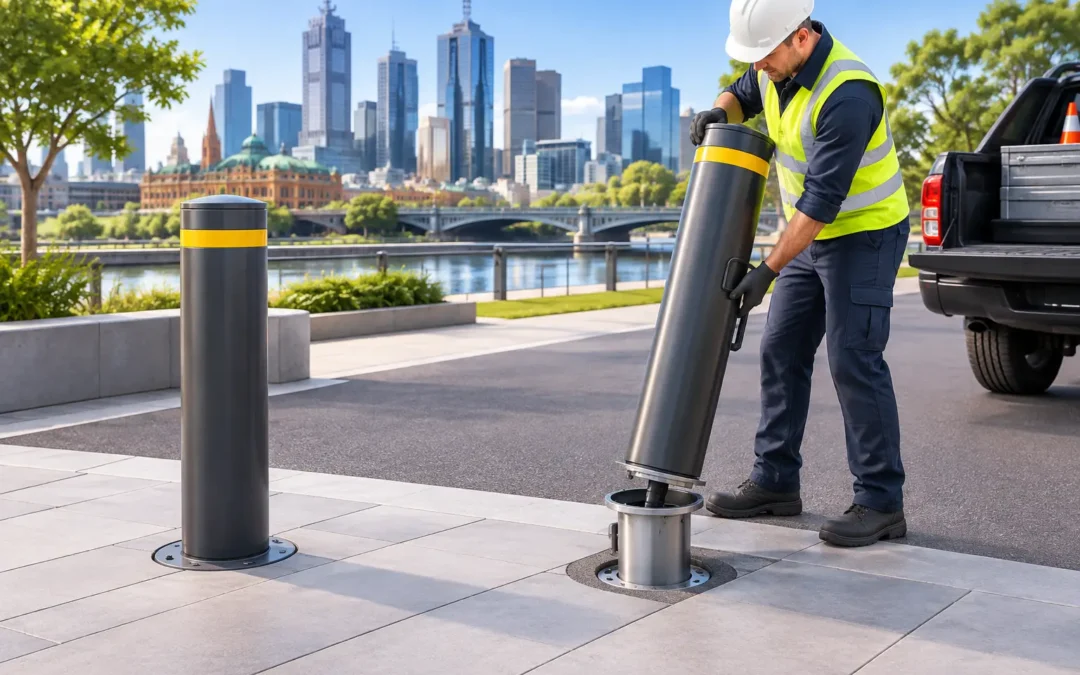
A loading bay that needs to stay clear during deliveries, a school entrance that must remain protected at drop-off, or a driveway that occasionally needs vehicle access all call for the same thing: control without permanently closing off the area. Removable bollard installation Melbourne property owners and managers can rely on starts with understanding how the space is used at different times of day.
Unlike fixed bollards, removable units provide a physical barrier when required and can be taken out when authorised access is needed. The benefit is obvious, but the installation has to be properly planned. A bollard that is poorly positioned, set in an inadequate footing or supplied with the wrong locking arrangement can become inconvenient, unsafe or ineffective.
Where removable bollards make sense
Removable bollards are commonly used wherever pedestrian safety, asset protection and vehicle access need to coexist. They are a practical option for commercial forecourts, industrial yards, schools, strata properties, sporting facilities and residential driveways.
At a retail or commercial site, bollards can prevent vehicles entering a pedestrian zone after hours while allowing service vehicles through at set times. At schools and community facilities, they can close a vehicle access point during busy periods without creating a permanent barrier for maintenance crews or emergency services. For homeowners, a pair of removable bollards can help secure a side driveway, protect a caravan or trailer area, or restrict access to a rear yard.
The right application depends on the real traffic pattern, not just the site plan. Consider who needs access, what vehicles use the opening, how often the bollards will be removed and who will be responsible for the keys. These answers shape the bollard type, sleeve design and layout.
Planning removable bollard installation in Melbourne
Melbourne sites present a broad range of conditions. A compact inner-suburban commercial lot may have tight service clearances and buried services close to the surface. A Mornington Peninsula property may need to account for sloping ground, sandy conditions or exposed weather. Industrial sites may require a more substantial solution due to regular truck movements and higher security requirements.
A site inspection is the sensible first step. It confirms whether the proposed locations offer enough clearance, whether the ground can support the required footing and whether existing services may be affected by excavation. It also prevents a common mistake: setting bollards to block cars but accidentally restricting access for wheelchairs, prams, maintenance equipment or emergency vehicles.
Before installation, a contractor should establish:
- the width and turning path required for authorised vehicles;
- the bollard diameter, height and material suited to the task;
- the location of underground electrical, water, gas, drainage and communications services;
- the locking method, storage arrangement and responsibility for removed bollards.
For many sites, the bollard is only one part of the access-control arrangement. A gate, fence line, chain-link enclosure or welded mesh perimeter may influence where it sits and how the opening operates. Looking at the entire boundary avoids awkward gaps and duplicated work later.
Selecting the right bollard system
Removable bollards are usually installed into a ground sleeve or receiver that is concreted into place. When the bollard is removed, a flush or recessed cap covers the sleeve, reducing trip risk and keeping rubbish out of the socket. The bollard is then locked into the receiver when in use.
Steel bollards are a common choice for security and vehicle deterrence. They can be galvanised for corrosion resistance and finished in a suitable colour where visibility or site presentation matters. In higher-risk areas, a heavier-duty specification may be needed, but more mass is not always the answer. If staff will remove the bollards frequently, a unit that is too heavy can create handling issues and encourage people to leave the entrance unsecured.
Visibility also deserves attention. Bollards near vehicle paths, footpaths or shared accessways may need contrasting finishes, reflective bands or other visibility measures. The aim is to stop unauthorised vehicles without creating a hazard for authorised drivers, cyclists or pedestrians.
Spacing is a security decision
Bollard spacing should prevent the vehicle type you want to exclude while keeping the approved route clear. This sounds straightforward, yet it is where many installations fall short. A gap that stops a car may still permit a motorcycle, small vehicle or trolley, depending on the security risk. Conversely, a tight arrangement may make it difficult for delivery vehicles to enter safely.
The outside edges of bollards, not just their centre points, need to be considered. So do kerbs, gate posts, garden beds and adjacent walls. Where a wide opening is needed, multiple bollards may work better than one central removable post because they can define the traffic path more clearly.
For fire access, disability access and public-facing sites, layout decisions should be checked against the relevant project requirements and applicable Australian Standards. Some locations may also need approval from a building manager, council or asset owner before work begins.
The installation process that protects the site
A professional installation is not simply a matter of digging holes and pouring concrete. The process should be controlled from set-out through to final clean-up.
First, the bollard locations are marked and checked against the access plan. This is the time to confirm alignment with gates, fence posts, kerbs and vehicle paths. The team then investigates services before excavation and establishes the footing size required for the product and ground conditions.
The receiver sleeves must be installed plumb and at the correct finished level. If a sleeve sits proud of the surrounding surface, it can create a trip point or be struck by tyres. If it sits too low or fills with concrete, dirt or water, the bollard may not seat and lock correctly. Accurate set-out matters as much as concrete strength.
Once the concrete footing has cured sufficiently, the bollard and locking components can be tested. The installation should be checked for smooth removal, positive engagement, key operation and a secure cap when the bollard is out. The surrounding area should also be left tidy, with spoil removed and any disturbed paving, asphalt or landscaping addressed as part of the agreed scope.
Avoiding common removable bollard problems
The most frustrating failures are usually preventable. One is installing a bollard without confirming underground services. Another is choosing a lock that is impractical for the people using it, particularly where multiple shifts or contractors require access.
Water and debris in the sleeve are also common issues. A quality receiver and cap help, but routine housekeeping remains necessary. On sites with leaves, gravel, mud or frequent vehicle traffic, nominate someone to inspect the sleeves and caps as part of normal maintenance.
Lost keys can bring operations to a halt, so key management should be decided before handover. Facilities managers may prefer a restricted key system, while a homeowner may only need a straightforward lock with a spare stored securely. The best option depends on the number of users and the consequences of unauthorised access.
It is also worth being realistic about impact protection. Standard removable bollards can deter vehicle entry and provide a clear physical boundary, but they are not automatically designed to withstand every high-speed or heavy-vehicle impact. Where a site has a specific anti-ram or engineered impact requirement, the product and footing need to be specified for that purpose.
Matching bollards to the wider site
A well-planned removable bollard system should look intentional rather than added as an afterthought. It can align with tubular fencing at a school, protect a sliding gate at an industrial yard, or complement a custom boundary treatment at a residential property. Colour, finish and positioning can keep the result practical without undermining the appearance of the frontage.
For sites with recurring access issues, it can be useful to map the daily routine before choosing a solution. Observe the morning arrival period, deliveries, visitor parking, waste collection and after-hours security. Often, the best arrangement is the one that makes correct use easy for staff and visitors while making unauthorised vehicle access difficult.
With more than 40 years of fencing experience, Minster Fencing can assess the access point, ground conditions and surrounding perimeter works before providing an obligation-free, site-specific quote. A properly planned removable bollard installation gives a property the flexibility it needs without leaving security to chance.