
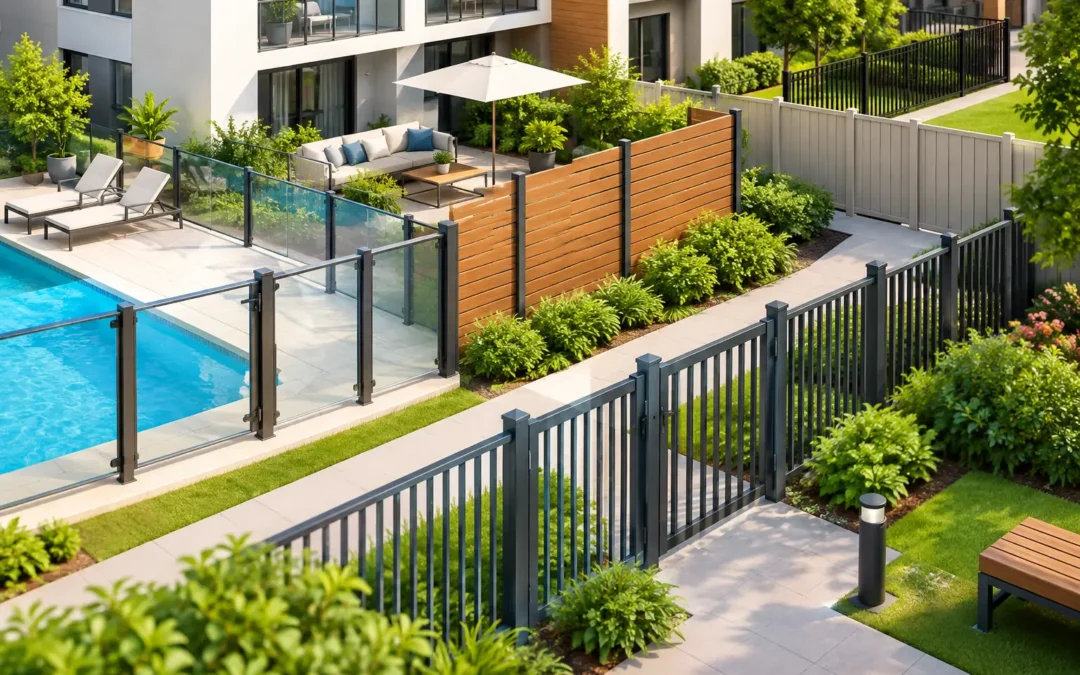
A damaged boundary fence, an unsecured bin area or a gate that never closes properly can quickly become a whole-of-property issue. The right strata fencing options do more than mark a boundary: they protect residents, manage access, improve privacy and help a shared property stay neat, safe and easier to maintain.
For owners corporations, strata managers and builders, the best system is rarely the cheapest fence per metre. It needs to suit the site, the people using it, local conditions and the level of ongoing maintenance the property can reasonably manage.
Start with the purpose of the fence
Strata properties often need several fencing solutions across one site. A low front boundary may need to remain open and welcoming, while a rear service area needs privacy. A pedestrian entry may need controlled access, while pool fencing has its own safety requirements.
Before choosing a material, establish what the fence must achieve. Is the priority screening between lots, keeping children away from a driveway, securing common property, enclosing rubbish bins, protecting equipment or improving the appearance of ageing boundaries? A clear purpose prevents a fence being specified for looks alone, then failing to perform where it matters.
It is also worth separating common-property work from lot-owner responsibilities early. Check the strata plan, existing by-laws and any approved maintenance arrangements before work begins. Boundary location, access through private courtyards, underground services and neighbouring owners can all affect the scope and cost of an installation.
Strata fencing options for common property
Colorbond fencing for privacy and clean boundaries
Colorbond fencing remains a practical choice for side and rear boundaries, service zones and areas where residents need screening from neighbouring properties. It is available in a broad range of colours, has a tidy uniform appearance and does not require regular painting like timber.
For strata sites, Colorbond can work particularly well around bin storage, plant areas and shared courtyards. Custom heights, stepped panels and compatible gates can help deal with changes in ground level or awkward boundary lines. Where noise, wind exposure or a more architectural finish is a concern, the design may need additional consideration rather than simply installing standard panels.
The trade-off is that a solid fence can catch wind and may feel imposing along narrow paths or street-facing areas. Good post sizing, footing depth and drainage planning are essential, especially on exposed Melbourne sites.
Tubular fencing for visible security
Tubular steel fencing is a strong option where visibility and access control matter. It suits front boundaries, apartment entries, shared driveways, school-adjacent sites, pool surrounds and pedestrian gates. Its open design allows sightlines through the property while creating a clear physical barrier.
A powder-coated tubular fence can be specified in colours that complement existing gates, brickwork or cladding. Depending on the application, the system may include lockable gates, self-closing pedestrian gates, keypad access or vehicle gates. For pools and areas used by children, the layout, gate hardware and clearances must be assessed against the applicable regulations and Australian Standards.
Tubular fencing is not intended to provide complete visual privacy. If residents overlook a busy common area, a separate screen, landscaping or a solid section of fencing may be more appropriate.
Welded mesh and chain-link for larger perimeters
For car parks, utility compounds, sporting areas, rear perimeters and larger common-property sites, welded mesh and chain-link fencing offer dependable containment at scale. Both allow airflow and visibility, which can be useful around electrical infrastructure, storage areas and back-of-house zones.
Chain-link fabric is highly adaptable. It can follow uneven ground, suit longer runs and be paired with matching swing or sliding gates. It is commonly selected for tennis courts, sporting grounds, commercial yards and practical perimeter security. Black or green finishes can reduce the visual impact where a more discreet result is preferred.
Welded mesh panels generally provide a more rigid, contemporary appearance. They are well suited to sites requiring a clean, consistent line and a higher level of resistance to cutting or climbing than basic chain-link. The right choice depends on security risk, site visibility, required height and budget.
Palisade fencing for high-security areas
Some strata developments include equipment yards, basement access points, communications infrastructure or isolated areas that require a more serious perimeter solution. Palisade fencing is designed for these higher-security applications. Its steel pales create a difficult barrier to climb or cut through, while retaining visibility for surveillance.
This is usually not the first choice for residential courtyards or decorative frontages. It is a purpose-built security product, best used where the consequences of unauthorised access are higher and a standard boundary fence is not enough.
Privacy screens, timber and feature fencing
Where resident amenity is the main issue, screening can be more useful than a perimeter fence. Timber batten screens, horizontal slats and custom cladding can soften common courtyards, separate ground-floor terraces or conceal services without closing off a space completely.
Timber offers warmth and can suit established residential settings, but it needs realistic maintenance planning. Exposure to sun and rain, irrigation overspray and contact with soil will affect its service life. Combining timber with steel posts or a Colorbond boundary can be a sensible way to achieve a tailored look while keeping the structural elements durable.
Gates are part of the fencing system
A fence only performs as well as its access points. On strata properties, gates receive frequent use and are often the first component to show wear. A pedestrian gate that drags, a latch that does not engage or a vehicle gate without adequate clearance creates daily frustration and can compromise security.
Specify gates around how the site actually operates. Consider delivery access, rubbish collection, emergency egress, pram and wheelchair movement, parking circulation and whether residents need keys, remotes, swipe access or an intercom. Swing gates need room to open safely, while sliding gates require sufficient run-back space and reliable ground conditions.
For high-use entries, durable hinges, latches and closers are worth including in the original scope. They cost less than repeated reactive repairs and support a cleaner, safer experience for residents and visitors.
Plan for levels, drainage and retaining work
Many fencing problems begin below ground level. Sloping blocks, retaining walls, unstable soil and poor drainage can affect post footings and create gaps beneath a fence. On a strata site, those gaps may become a security issue, allow rubbish to collect or create a pathway for pets and children.
Where fencing is proposed near a retaining wall, do not assume the wall can carry the load of new posts or panels. The retaining structure, soil pressure, drainage and fence design need to be considered together. A staged or stepped fence may be safer and more practical than forcing a level line across a sloping boundary.
Site investigation should also account for underground services. Dial-before-you-dig information, visible pits, existing drainage and access limitations should be reviewed before posts are excavated. This is particularly relevant in established apartment complexes, where services may not follow obvious paths.
Compliance and approval should happen before ordering
A committee-approved colour or style does not automatically mean the installation is compliant. Fence height, pool-barrier requirements, gate operation, shared access and building interfaces may all be subject to regulations, planning controls or Australian Standards.
For owners corporations, a straightforward process is to document the reason for the work, confirm ownership and boundaries, obtain a site-specific quote and have the proposed scope approved through the proper process. If the work affects a neighbour, a public frontage, a pool area or a fire-access route, allow time for the additional checks.
A professional fencing contractor can identify practical construction issues at the quoting stage, including access for equipment, removal of old fencing, post-hole conditions and suitable gate locations. This makes the final price more reliable and reduces the chance of disruptive variations once work has started.
Choose for the next ten years, not the next meeting
The best fencing decision balances appearance, privacy, security, maintenance and cost over time. A basic system may suit a low-risk side boundary, while a shared entry or pool area deserves a more carefully specified solution. Matching every part of a complex with the same fence is not always necessary or cost-effective.
For strata properties across Melbourne and the Mornington Peninsula, Minster Fencing can assess the site, recommend practical material options and provide an obligation-free quote for supply and installation. A well-planned fence gives residents confidence every time they come home, without creating another maintenance problem for the committee.