
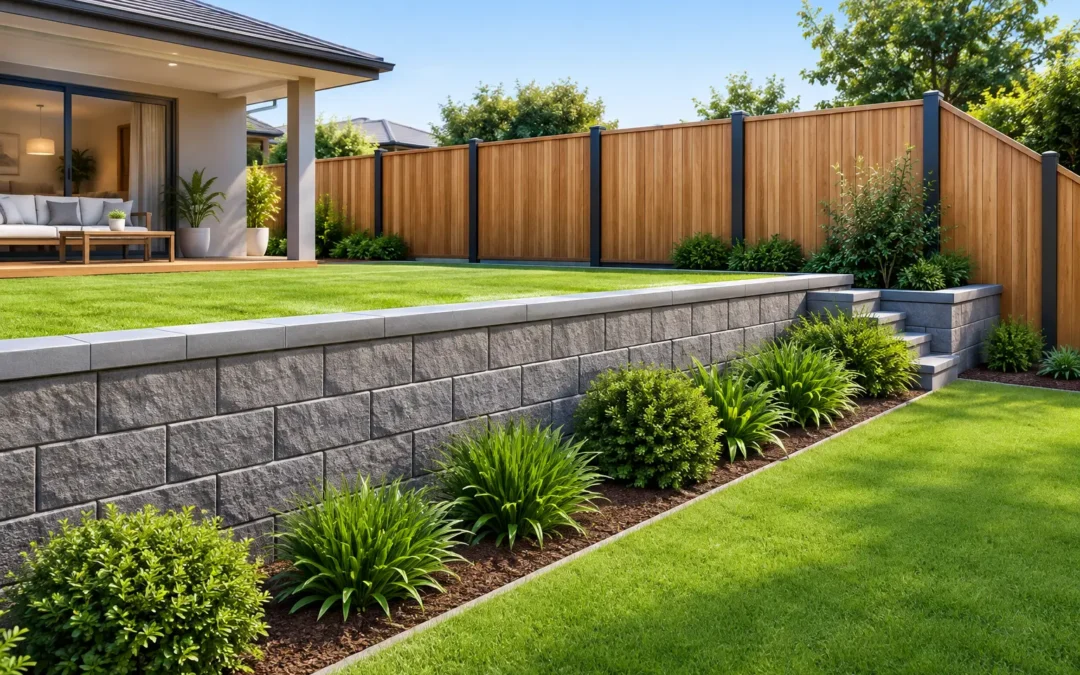
A fence that looks straight on handover day can start leaning within a season if the ground behind it has not been properly retained. For retaining wall and fencing Melbourne projects, the order of work, drainage, soil conditions and post placement all matter just as much as the finished look.
Melbourne properties often have sloping blocks, newly levelled building sites, clay soils and tight side boundaries. A retaining wall may be needed to create a usable yard, protect a neighbouring property level or support a fence line. Treating the wall and fence as separate jobs without considering how they interact is where expensive problems can begin.
Retaining wall and fencing Melbourne projects need a plan
The first question is not which fence style looks best. It is what the wall needs to hold back, where water will go and whether the fence will create extra load on the structure. A low garden edge has very different requirements from a wall supporting a raised driveway, a boundary between two homes or a commercial hardstand.
A site inspection should establish the height difference across the block, soil type, access for machinery, underground services, neighbouring levels and the proposed fence type. It should also identify whether the wall is close to a boundary, building, pool area or drainage line. These details influence the right construction method and whether engineering or council approvals may be required.
For residential work, the goal is often a clean, level backyard with a durable privacy fence above or behind the wall. On commercial, industrial and education sites, the focus may shift to perimeter security, access control and the ability to withstand regular use. The system still needs to work as one – a solid wall, suitable drainage and a fence specified for the site.
Start with the retaining wall, not the fence
Retaining walls do more than hold soil in place. They manage changes in ground level and direct pressure away from areas that need to remain stable. The higher the retained ground, the more carefully the wall needs to be designed and built.
Common options include treated timber sleepers, concrete sleepers, masonry and engineered systems. Timber can suit lower residential walls where a natural finish is preferred and the site conditions are appropriate. Concrete sleepers provide a long-lasting, uniform option and are often selected for their strength and low maintenance. The best choice depends on wall height, exposure, access, budget and the finish required around the property.
Drainage is non-negotiable. Water trapped behind a wall adds pressure, saturates soil and can lead to movement over time. Proper drainage generally involves free-draining material behind the wall and a suitable drainage path to carry water away. The exact detail depends on the site, but a wall that has no plan for water is not a finished wall.
Where a wall is substantial, supports a load, sits near a boundary or affects a neighbouring property, the project may need engineering input and approvals. Requirements vary by site and local council. Getting this checked before construction is far simpler than trying to correct an unsuitable wall once fencing and landscaping are complete.
Fence posts must not compromise the wall
One of the most common decisions is whether fence posts can be installed through the retaining wall. The answer is: it depends on the wall system and the fence being installed.
Fixing fence posts directly into or through sleepers may appear tidy, but it can weaken the retaining system if it has not been designed for that purpose. A tall solid fence also catches wind. That wind load is transferred through the posts and can place force on the wall, particularly on exposed blocks or along long boundary runs.
In many situations, independent posts installed behind the wall are the better approach. This keeps fence loads separate from the retaining structure while maintaining a neat finished line. In other cases, purpose-designed steel posts or brackets can be incorporated as part of the retaining wall construction. The right detail should be decided before materials are ordered, not improvised once the wall is in place.
This is especially relevant for Colourbond fencing and timber paling fencing because both can create a broad wind-catching surface. Tubular fencing, chain-link fabric and welded mesh allow more air through, which can change the loading consideration, but they still need correctly positioned and concreted posts.
Choose fencing for privacy, security and the site
A retaining wall creates the level change. The fence needs to suit how the space will be used.
Colourbond fencing is a practical choice for many Melbourne homes because it is private, clean-lined and available in colours that work with contemporary exteriors. It is well suited to side and rear boundaries, provided the posts and rails are properly installed for the conditions.
Timber fencing remains popular where a warmer, more traditional look is wanted. It can work well alongside timber or concrete sleeper walls, and timber cladding can soften the appearance of a structural retaining system. Like any fence, it needs suitable clearances from soil and garden beds to help manage moisture and reduce premature deterioration.
Tubular fencing is often selected for front boundaries, pools, schools and commercial sites where visibility matters. It provides definition and security without closing off the property. Chain-link and welded mesh fencing suit sporting areas, industrial yards, storage areas and larger sites where strength, visibility and cost-effective coverage are priorities.
For higher-security applications, palisade fencing, security gates and bollards may be considered alongside the retaining work. A well-planned perimeter should account for pedestrian access, vehicle movements, gate swing or sliding clearance, and the final ground levels on both sides of the fence.
Do not overlook boundaries and neighbours
Boundary retaining wall and fencing work can affect more than one property. Before work begins, confirm the boundary location rather than relying on an old fence position. A fence that has stood in the same place for years is not always exactly on the title boundary.
It is also worth discussing proposed levels, wall height and access with affected neighbours early. Clear communication can prevent disputes over spoil, drainage, temporary access and the final fence finish. If the project involves shared boundary fencing, responsibilities and contributions may need to be considered under Victorian fencing requirements.
Access is another practical issue. A narrow side passage can limit machinery and material handling, while a steep block may require different construction sequencing. An experienced contractor will allow for these realities in the quote instead of treating them as unexpected extras halfway through the job.
A clean installation is about more than appearance
Good retaining and fencing work should leave the site safe, stable and ready for the next trade or for landscaping. That means setting out accurately, managing excavated soil, keeping materials organised and removing construction waste at completion.
The installation sequence is important. Generally, the wall is established first, drainage and backfill are completed correctly, and the fence is installed once the structure and final levels allow for it. Rushing to erect fencing before the retained area is stable can create alignment issues or make later drainage work difficult.
Materials and installation should also suit relevant Australian Standards and the intended application. This matters particularly for pool barriers, school fencing, commercial security systems and gates, where poor specification can create safety, compliance and maintenance issues.
Minster Fencing brings more than 40 years of fencing experience and four generations of family trade knowledge to projects across Melbourne Metro, the Mornington Peninsula and South Eastern Melbourne. For homeowners, builders and facilities teams, the value is in having the wall, fence and access requirements considered together from the outset.
If your block has a level change, an ageing boundary fence or a new build that needs final perimeter works, arrange a site-specific, obligation-free quote before the groundworks begin. A properly planned wall and fence will give the property a cleaner finish, a stronger boundary and far fewer problems to solve later.