
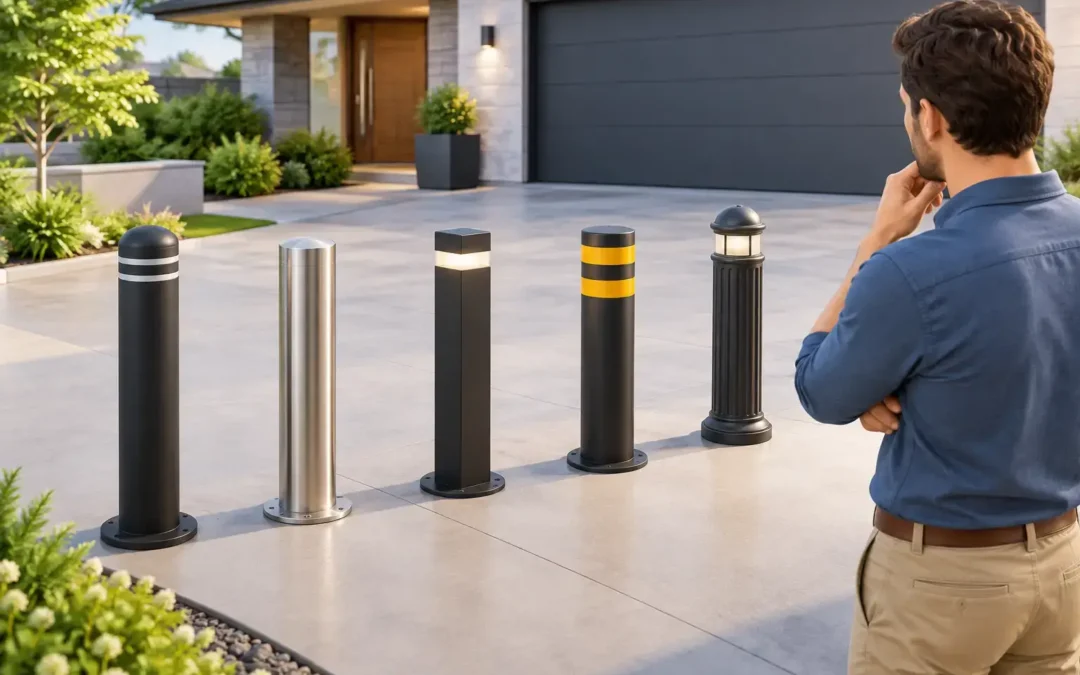
A driveway bollard can do far more than mark where vehicles should stop. It can protect a garage, roller door, gate motor, wall, loading area or pedestrian entry from costly accidental damage. Knowing how to choose driveway bollards starts with a practical question: what needs protecting, and who still needs to get through?
For a home, the answer may be keeping a car clear of a corner of the house while allowing daily access. For a school, strata complex, warehouse or sporting facility, bollards may need to manage delivery vehicles, restrict unauthorised entry and separate people from moving traffic. The right product depends on the site, not simply on the appearance of the bollard.
Start with the job the bollard needs to do
Driveway bollards are often described as security bollards, but security means different things on different sites. A light-duty bollard that provides a visual guide at a residential driveway is not necessarily suitable for stopping a vehicle at a commercial entry. Before selecting a style, identify the realistic risk.
Consider whether the bollard is there to prevent parking on a footpath, protect a gate, stop vehicles reaching a building, control after-hours access, or guide cars through a narrow entrance. Also think about the vehicles using the driveway. A family sedan, rubbish truck, delivery van and loaded ute place very different demands on the area.
If the bollards are intended to resist deliberate vehicle impact or protect a high-risk asset, specialist engineering and a site-specific specification may be required. Do not assume that any steel post will provide a rated vehicle barrier. The footing, steel section, installation depth and surrounding ground conditions all affect performance.
Fixed, removable or automatic bollards?
The best choice usually comes down to how often access needs to change. Fixed bollards suit locations where vehicles should never enter, or where permanent protection is required. They are commonly installed near garage corners, building walls, fuel areas, loading-zone infrastructure and pedestrian paths. Once concreted in, they provide a simple, low-maintenance barrier.
Removable bollards are a practical option where access is needed occasionally. A homeowner may remove one to bring a caravan, trailer or landscaping equipment through a side driveway. A facilities manager may need a clear opening for maintenance vehicles, emergency access or event set-up. The bollard is removed from a ground socket, which can be capped when not in use.
Automatic or retractable bollards may suit sites with frequent authorised access, such as managed car parks or commercial entries. They offer convenience but need appropriate controls, drainage, servicing and safety planning. For many residential and small commercial driveways, a well-installed removable bollard is the more straightforward and cost-effective solution.
Choose the right material and finish
Steel is the usual choice where strength and durability are priorities. Galvanised steel provides corrosion resistance, which matters in Melbourne’s changing weather and is particularly relevant for bayside and Mornington Peninsula properties. Powder-coated finishes can be selected to complement fencing, gates and building colours.
Stainless steel can provide a clean architectural finish, but it is not automatically the best answer for every site. It may cost more, and a polished finish can show marks in busy areas. Painted or powder-coated steel is often the more practical option where a visible, hard-wearing traffic-control feature is needed.
For low-impact marking or pedestrian guidance, flexible polymer bollards may be suitable. They can reduce damage from minor contact, but they do not provide the same level of physical protection as a properly installed steel bollard. This trade-off should be clear from the outset.
Visibility also matters. A dark bollard can suit a contemporary residential frontage, yet it may be difficult for drivers to see in poor light. Reflective bands, contrasting colours or suitable lighting can make a significant difference at tight driveway entrances, shared car parks and service areas.
Match the size and strength to the location
Bollard diameter, wall thickness, height above ground and footing depth should be chosen as a system. A taller or wider bollard may look stronger, but the installation beneath ground is equally important. A substantial post with an undersized concrete footing can still move or fail under force.
There is no single size that suits every driveway. Residential protection may call for a modest steel bollard positioned to shield a vulnerable corner. Commercial sites with regular truck movements may need heavier-duty units and deeper footings. Soil conditions, existing pavement, drainage and underground services must be checked before excavation begins.
Avoid choosing purely by price or by the visible section above ground. The better question is whether the bollard and footing are appropriate for the expected vehicle movements and level of protection. An experienced installer can assess this during a site measure and recommend a practical specification.
Plan placement before drilling or digging
Poor placement can make a safe driveway frustrating to use. Bollards need enough clearance for the vehicles that use the entry, including mirrors, turning circles and trailers. They should not narrow an opening so much that drivers are forced close to gates, retaining walls or pedestrian areas.
At the same time, wide gaps can defeat the purpose of access control. If a vehicle can simply pass around a bollard, it may only provide a visual cue rather than a physical barrier. The desired outcome should guide the spacing.
Pay close attention to gate swings, sliding gate travel, intercoms, letterboxes, drainage pits and garage-door clearances. Bollards installed too close to a sliding gate can interfere with its path or future servicing. At a shared entry, keep pedestrian movement in mind and avoid creating a pinch point for prams, wheelchairs or people carrying equipment.
Before installation, identify underground services such as electrical cables, water pipes, gas, communications and irrigation. This is especially important for automated gates, where cabling may run across or alongside the driveway. Existing concrete may also need coring rather than simple excavation, depending on the design and condition of the slab.
Consider access, safety and compliance together
A driveway entry works best when security does not create a new hazard. Removable bollards should use a locking arrangement suited to the people responsible for access. If several staff members, tenants or trades need entry, establish who holds keys and how the bollard will be stored when removed. A removable unit left lying beside a driveway soon becomes a trip hazard or an obstacle for mowers and vehicles.
For commercial, education and industrial sites, the bollard layout should be considered alongside pedestrian routes, disability access, fire access and operational traffic flow. Requirements can vary depending on the property, council conditions and the wider scope of works. Where applicable, materials and installation should meet relevant Australian Standards and project specifications.
It is also worth considering what happens after hours. A removable bollard may be ideal during business hours but ineffective if it is regularly left out overnight. Conversely, a permanently fixed bollard may cause operational problems if deliveries are infrequent but essential. The most dependable system is the one that staff, residents or visitors can use correctly every day.
Do not overlook the surrounding driveway
A bollard installation is only as good as the surface and ground supporting it. Cracked concrete, loose asphalt, poorly compacted soil and water pooling around the base can shorten the life of the installation. Drainage is particularly important for ground sockets used with removable bollards, as debris and water can make them difficult to operate.
If you are upgrading gates, fencing or access controls at the same time, plan the bollards as part of the whole entry. Matching the finish to tubular fencing, Colourbond fencing or gates creates a cleaner result, but the operational details come first. A neat-looking driveway that prevents a gate from opening fully is not a successful installation.
Minster Fencing brings more than 40 years of fencing and access-control experience to driveway bollard installations across Melbourne and the Mornington Peninsula. A site-specific quote allows the team to assess vehicle access, footing requirements, gates, services and the level of protection required before work begins.
The right driveway bollard should quietly do its job for years: protecting the areas that matter, keeping access manageable and looking at home with the rest of the property. A professional site assessment before installation is the simplest way to make sure it does exactly that.