A sloping block can make an otherwise simple boundary fence far more involved. If you are asking what fence suits sloping blocks, the answer depends on how steep the fall is, whether the fence must provide privacy or security, and whether retaining and drainage work are part of the job. The best result is rarely achieved by forcing a standard fence line across uneven ground. It comes from measuring the site properly and choosing a system designed to follow, step over or work with the slope.
For Melbourne homes, commercial sites and schools, the practical choice usually comes down to a stepped fence, a raked fence, or a purpose-built combination that includes retaining. Each has a place, and each creates different considerations around appearance, ground clearance, cost and long-term performance.
What fence suits sloping blocks: stepped or raked?
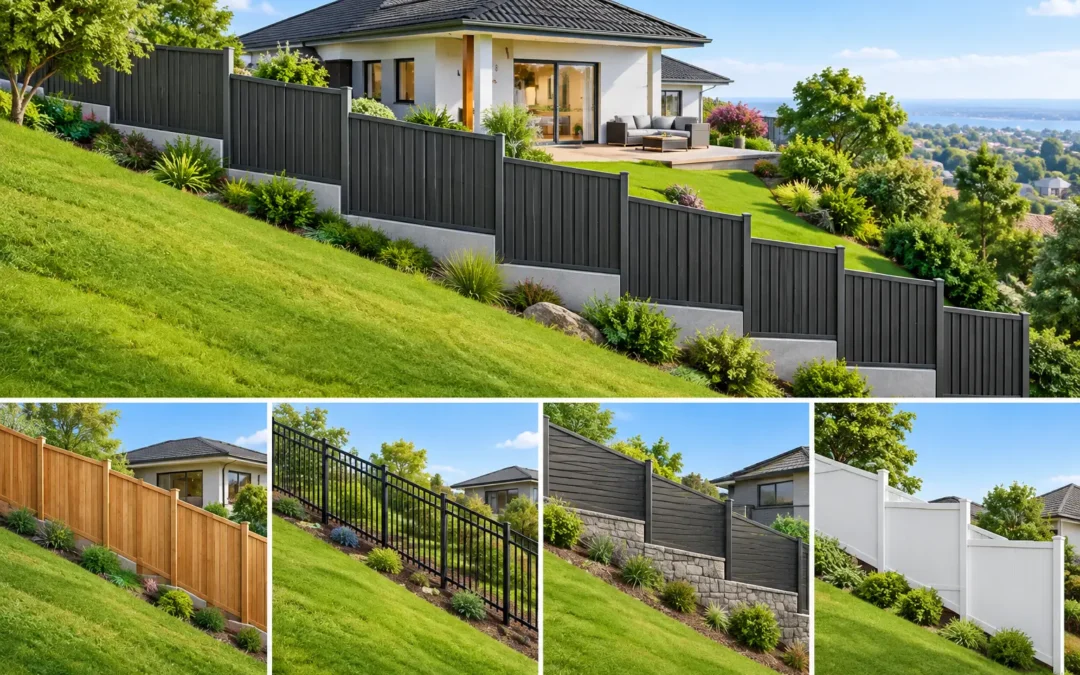
A stepped fence is installed in level sections, with each panel or bay dropping down at the posts as the ground falls away. It creates a distinct stair-step profile along the top of the fence. This approach is common for Colorbond fencing, timber paling fencing and many panel fence systems because standard materials can be cut and fitted in manageable sections.
Stepped fencing is often the most economical option on a moderate slope. The posts remain plumb, installation is straightforward, and the fence can be built using standard-height panels. It also provides a neat, deliberate look when the levels are set out carefully.
Its main trade-off is at ground level. As the fence steps down, triangular gaps can appear beneath the lower edge of panels. On a backyard boundary, those gaps may be unacceptable if you need to contain a dog, prevent access, or maintain privacy. They can be closed with treated timber plinths, purpose-made infill, concrete mowing strips or minor ground shaping, depending on the site.
A raked fence follows the angle of the land in a continuous line. Rather than dropping at every post, the rails or panels are angled to match the slope. This generally gives a smoother finish and reduces gaps beneath the fence, making it a strong option where containment, security or a clean visual line matters.
Raked fencing requires more planning and, in many cases, more custom fabrication. Tubular steel fencing, chain-link fabric and welded mesh systems can often be raked effectively. Timber can also be constructed to follow a slope, although the design needs to account for rail positions, paling lengths and consistent strength across the run. The extra labour and custom work can add to the cost, but it may be worthwhile on a visible frontage or a steeply graded block.
Match the fence material to the purpose
The slope is only one part of the decision. A good fence must suit the way the property is used, the level of privacy required and the exposure to wind, moisture and everyday wear.
Colorbond fencing for private boundaries
Colorbond fencing is a popular choice for residential boundaries because it is private, durable and available in colours that work with most Melbourne homes. On sloping blocks, it is typically stepped in bays. With proper set-out, matching plinths and well-positioned posts, a stepped Colorbond fence can look tidy and provide dependable screening.
Where the slope is gradual, the stepped profile is usually unobtrusive. On a sharper fall, consider whether the visible changes in height will suit the property, particularly from a patio, driveway or neighbouring yard. Custom-made panels and carefully planned transitions can improve the finish, but the fence still needs to be installed with enough clearance to avoid corrosion risks from constantly damp soil.
Timber fencing for a flexible finish
Timber paling fencing is adaptable on uneven residential land. Palings can be cut to suit the ground line, and the fence can be stepped or raked depending on the design. It is a practical choice where a natural finish is preferred or where an existing timber boundary needs to be continued.
The quality of the structure matters on a slope. Posts must be set to appropriate depths, rails need sound fixing, and the bottom of the fence should not sit in wet soil. A fence that follows the land closely can look excellent, but it still needs enough separation and drainage to avoid premature timber deterioration.
Tubular fencing for frontages and pools
Tubular steel fencing suits sloping front boundaries, access areas, schools and pool surrounds because it can be manufactured or adjusted to rake with the land. Its open design maintains visibility and airflow while providing a defined, secure boundary.
For pool fencing, the slope must be considered alongside the applicable safety requirements. Ground gaps, climbable objects, gate operation and fence height all need careful assessment. A pool barrier should never be treated as a standard boundary fence with a gate added later.
Chain-link and welded mesh for larger sites
Chain-link fabric is one of the most practical fencing options for sloping blocks, particularly on commercial, industrial, sporting and rural-style sites. It can follow changing ground levels efficiently, making it suitable for long runs where a rigid panel system would require extensive stepping or earthworks.
Welded mesh fencing is another strong choice where a more rigid, contemporary security fence is required. Depending on the product and site grade, panels may be stepped, raked within their design limits, or combined with custom sections. For schools, storage areas, plant yards and commercial boundaries, the right mesh height, post spacing and gate arrangement are just as important as the fence line itself.
Retaining comes before fencing when the ground needs support
A fence is not a retaining wall. If one side of the boundary is holding back soil, the retaining structure must be designed to carry that load before the fence is installed. Placing fence posts into a retaining wall without the right design can compromise both the wall and the fence.
This is especially relevant on new builds and renovated properties where levels have changed. Soil pressure, water movement and surcharge loads from driveways, buildings or neighbouring land can all affect the retaining solution. Drainage behind the wall is equally important. Water trapped in the soil adds pressure, creates movement and can shorten the life of the structure.
On some projects, a low retaining wall with a fence above is the cleanest way to achieve privacy and a usable yard. On others, it may be better to retain the land separately and install the fence at natural ground level. The right approach depends on the levels, soil conditions, access and boundary position.
Plan the fence line before installation starts
Sloping sites reward accurate preparation. Before choosing a fence style, identify the actual boundary, any easements, existing services, tree roots, drainage lines and access constraints. A fence that looks simple on a plan can become difficult if post holes are close to rock, concrete, buried services or a narrow side passage.
Consider where the fence meets gates, buildings and retaining walls. Gates need level, stable ground to operate reliably, so a gate opening on a steep slope may need a landing, a custom gate design or a change in position. For driveways, pedestrian access and service areas, the finished ground levels should be resolved before the fence is measured.
It is also worth thinking about your neighbour’s side of the boundary. A stepped fence may look even from one yard but expose larger gaps or different panel heights from the other. Clear discussion before work begins can prevent avoidable disputes and help both properties achieve a practical result.
When a custom fence is the better investment
Standard panels can work well on gentle slopes. Once the ground drops sharply, changes direction or includes retaining, a custom approach is often better value than trying to make off-the-shelf materials fit. This does not always mean an elaborate fence. It may simply involve custom-length panels, adjusted post heights, raked sections around a gate, plinths at low points and carefully designed transitions.
For security fencing, the stakes are higher. Large gaps below a fence, weak transitions between levels or poorly supported posts can undermine the whole perimeter. Industrial facilities, schools and commercial properties should consider access control, climbing resistance, gate security and relevant Australian Standards as part of the specification, not as an afterthought.
Get a site-specific recommendation
There is no single fence that suits every sloping block. A gradual backyard fall may suit stepped Colorbond or timber fencing, while a steep frontage may look and perform better with raked tubular steel. A long commercial boundary may call for chain-link fabric or welded mesh that follows the grade with fewer interruptions.
With more than 40 years of fencing experience, Minster Fencing can assess levels, access, materials and retaining requirements before recommending a practical solution. A site measure and obligation-free quote give you a clear path forward, with a fence designed to sit properly on the land rather than fight against it.