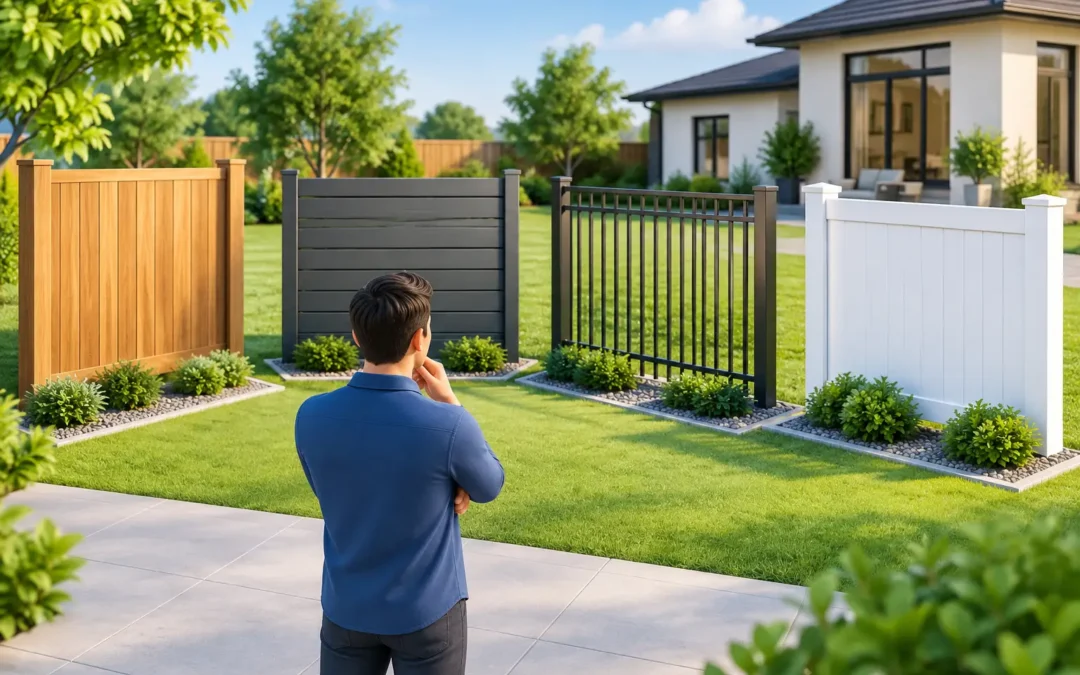
A boundary fence has to do more than mark where one property ends and another begins. It may need to keep children and pets contained, screen a neighbour’s view, protect stock or equipment, control access, and stand up to Melbourne’s changing weather. Knowing how to choose boundary fencing starts with the job the fence must perform – not simply the look you prefer from the street.
A low-cost fence that is poorly matched to the site can quickly become a maintenance issue, a security weak point or a source of disagreement with adjoining owners. Taking the time to assess the boundary, ground conditions and future use will lead to a better result.
Start with the purpose of the boundary
Most projects have one main purpose, but several secondary requirements. A rear residential boundary may call for privacy and a clean finish, while a side boundary near a driveway may need a gate and enough clearance for vehicles. A school, commercial yard or industrial site may place security, visibility and controlled access ahead of privacy.
Be clear about what the fence needs to achieve before selecting a material. If privacy is the priority, solid Colourbond or timber fencing can provide effective screening. If you need to secure an area without blocking sightlines, chain-link fabric, tubular fencing or welded mesh may be more suitable. For higher-risk sites, palisade fencing, anti-climb considerations, secure gates and bollards may form part of the wider perimeter solution.
It is also worth considering how the property will be used in five or ten years. A simple side fence may later need a pedestrian gate, pool equipment access or room for a new shed. Planning these practical details early can avoid removing sections of new fencing later.
Confirm the boundary before work begins
A fence should not be used to guess the legal boundary. Existing fences are not always built on the correct line, particularly on older blocks, sloping sites or properties that have been subdivided. Check your plans, title information and any available survey documentation before setting out the work. Where the line is uncertain, obtain professional surveying advice.
For dividing fences, speak with the adjoining owner before materials are ordered. A clear conversation about the location, height, style, cost contribution and access for installation is usually far easier than resolving a dispute after posts are in the ground. If the work affects a retaining wall, drainage path or shared accessway, make sure these items are discussed as well.
Local council requirements, planning controls, estate covenants and pool safety rules can also affect what is permitted. Requirements vary by location and fence type, so do not assume a fence that works on one street is suitable for every site. A capable fencing contractor can identify practical issues during a site inspection, but approvals and boundary confirmation should be addressed before installation is scheduled.
Match the fencing material to the site
There is no single best boundary fence. The right choice depends on exposure, terrain, maintenance expectations, budget and the level of privacy or security required.
Colourbond and panel fencing
Colourbond fencing is a popular choice for Melbourne homes because it provides privacy, has a neat consistent finish and does not require painting. It works well along side and rear boundaries where neighbours are close, and custom colours can help it suit the building and surrounding landscape.
Its performance depends on correct post spacing, footings and installation. On exposed sites, wind loading needs careful consideration. Where there is a change in ground level, stepped panels or purpose-designed retaining solutions may be required rather than forcing panels to follow an unsuitable slope.
Timber fencing
Timber paling fencing offers a traditional appearance and can be a practical choice for residential boundaries. It can be adapted to uneven ground and may suit homes where a warmer, more natural finish is wanted. Timber also allows for capping, exposed posts or cladding details where the appearance from each side matters.
The trade-off is maintenance and lifespan. Timber is exposed to moisture, soil contact, insect activity and sun. Good-quality materials, correct ground clearance and sound construction make a real difference, but homeowners should still expect timber to weather over time.
Chain-link fabric and welded mesh
Chain-link fencing remains a reliable option for large boundaries, tennis courts, sporting grounds, storage areas and commercial sites. It is economical over longer runs, allows airflow and visibility, and can be specified in different heights and wire gauges to suit the application. Black or green finishes can reduce its visual impact in some settings.
Welded mesh can provide a more rigid, modern appearance where stronger perimeter definition or a higher security level is required. Both options work particularly well where surveillance matters. A solid privacy fence can conceal a site, whereas open fencing allows staff, neighbours or security cameras to see what is happening around the perimeter.
Tubular and palisade fencing
Tubular fencing is often selected for front boundaries, schools, strata properties and commercial entries because it presents well while maintaining visibility. It can be combined with matching pedestrian and driveway gates for a consistent result.
Palisade fencing is generally better suited to sites that need a more serious security boundary. Its strength, height and deterrent appearance make it appropriate for industrial facilities, compounds and areas containing valuable equipment. However, it may be unnecessary for a quiet residential boundary, where it can feel visually heavy and add cost without delivering a proportionate benefit.
Consider height, privacy and neighbour impact
Fence height changes both performance and appearance. A higher fence may improve privacy and reduce access opportunities, but it can also create shade, restrict airflow and feel imposing in a small courtyard. On sloping land, a tall stepped fence can create gaps underneath or an uneven top line if the design is not carefully planned.
Think about sightlines from windows, outdoor living areas, driveways and gates. For front boundaries, visibility is often helpful for safe vehicle movements and visitor access. For side and rear boundaries, privacy may matter more. The best balance is often different on each edge of the property.
If a fence will sit near a retaining wall, do not treat it as a separate job. Retaining and fencing loads need to be considered together. Posts installed in the wrong place can compromise drainage or the wall structure, while water held behind a fence line can shorten the life of timber and steel components.
Build access and drainage into the design
Boundary fencing should make the site easier to use, not create daily frustrations. Decide where pedestrian gates, vehicle gates, bin access and maintenance access are needed. Consider gate swing direction, latch location, clearance from paths and whether vehicles will need to enter with trailers, deliveries or equipment.
Drainage deserves the same attention. Water should not be trapped against posts, directed into a neighbour’s property or allowed to undermine footings. This is especially relevant on the Mornington Peninsula and across Melbourne’s sloping or clay-heavy sites, where ground movement and runoff can affect long-term fence alignment.
For commercial, education and sporting sites, access control may extend beyond a single gate. It can involve separate pedestrian and vehicle entries, lockable compounds, removable bollards, emergency access and fencing that connects safely to existing buildings or retaining structures.
Choose workmanship, not just a quoted price
Two quotes for what appears to be the same fence can differ for valid reasons. One may allow for better posts, deeper footings, galvanised components, removal of old fencing, difficult access, gate hardware or careful work around services. Another may leave those matters unclear until the job is underway.
Ask what is included and how site conditions will be handled. A professional quote should identify the fencing system, approximate height and length, gates, demolition or disposal where required, and any assumptions about access, ground conditions and boundary set-out. For specialised or security fencing, ask whether the materials and installation will meet relevant Australian Standards and project requirements.
Experience is particularly valuable where the job involves slopes, retaining walls, unusual angles, long commercial runs or high-security access points. Minster Fencing brings more than 40 years of operational experience and four generations of family trade knowledge to site-specific fencing work across Melbourne and the Mornington Peninsula.
How to choose boundary fencing with confidence
The strongest fencing decision is rarely based on one factor alone. It brings together the correct boundary line, the purpose of the fence, appropriate materials, drainage, access, neighbour considerations and installation quality. A fence that looks right on day one should still be stable, usable and fit for purpose years later.
Before committing, arrange a site inspection and discuss the conditions that cannot be seen in a catalogue: slope, soil, wind exposure, access, existing structures and future plans. A clear, obligation-free quote from an experienced local fencing team gives you a practical starting point for a boundary that will do its job properly.