
A fence around a school oval, factory yard or Melbourne backyard has to do more than mark a boundary. It may need to contain people or equipment, protect an entry point, preserve sightlines and stand up to regular use. When weighing up chain wire versus welded mesh, the right choice comes down to what the fence must do on your particular site.
Both systems are proven options for residential, commercial, industrial and sporting applications. They can be galvanised, powder-coated in selected finishes and built with suitable posts, gates and footings. Their performance differs, however, in ways that affect security, appearance, budget and long-term maintenance.
Chain wire versus welded mesh: the practical difference
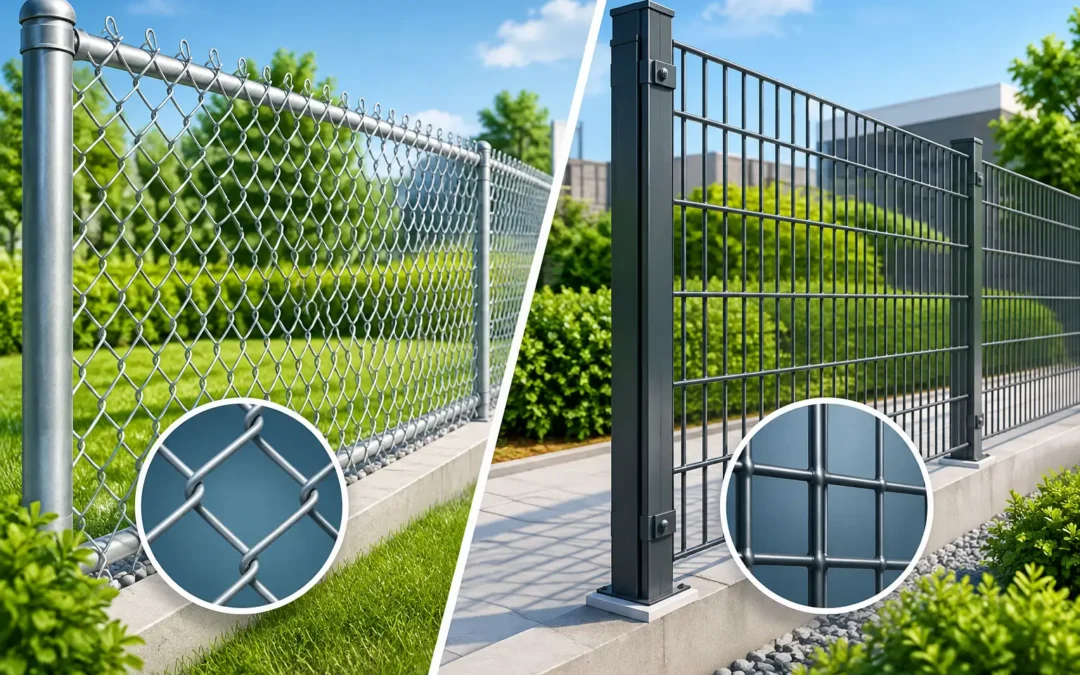
Chain wire is made from interwoven steel wire that forms a flexible diamond pattern. It is commonly known as chain-link fencing and has long been used for tennis courts, school grounds, gardens, storage areas and industrial perimeters. The fabric is tensioned between terminal posts, line posts and rails or tension wires to create a continuous fence.
Welded mesh is manufactured from straight horizontal and vertical wires welded at each intersection. Depending on the product selected, it may be supplied as roll mesh or rigid panels. The square or rectangular pattern creates a firmer, more structured finish than chain wire, particularly where welded mesh panels are used.
Neither is automatically the better fence. Chain wire is often the practical choice where a large area needs enclosing economically or where ground levels vary. Welded mesh can be the stronger visual and security choice where a clean, rigid perimeter is required. The detail of the installation matters as much as the fabric itself: post spacing, rail configuration, footing depth, gate design and site preparation all affect the finished result.
When chain wire is the sensible option
Chain wire remains popular because it covers long runs efficiently. For a sizeable yard, sporting area or rural-style boundary, it can provide dependable containment without closing off views or creating a heavy visual barrier. The open diamond pattern also allows airflow, which is useful around courts, play areas and exposed sites.
Its flexibility is a major advantage on undulating blocks. Rather than forcing a rigid panel to step across every change in level, chain wire can follow the contour of the ground more naturally. This can reduce unnecessary cutting, gaps underneath the fence and awkward transitions.
For tennis courts and sports grounds, chain wire is a familiar and effective solution. It can be specified at appropriate heights, with top rails, bottom rails or tension wire, and designed around access gates and ball containment requirements. Where a court enclosure is subject to regular impact, the fence needs a sound supporting frame and properly tensioned fabric, not simply a roll of wire attached to light posts.
Chain wire also suits sites where future alteration is likely. It can be practical to repair a localised section, extend a boundary or integrate new gates as site needs change. That said, it is not maintenance-free. A fence that is struck by vehicles, climbed regularly or allowed to loosen over time may need re-tensioning or repair.
Where welded mesh earns its place
Welded mesh is often chosen for its neat lines and more deliberate appearance. A rigid panel system can give a commercial frontage, school boundary or modern residential project a cleaner finish while retaining visibility through the fence. It is particularly effective where presentation matters alongside perimeter control.
The welded intersections make it more difficult to deform than standard chain wire in many applications. That can be valuable around commercial premises, plant areas, storage compounds and access-controlled sites. Smaller apertures and heavier wire options can also make climbing or cutting less convenient, although security should always be assessed as a complete system rather than by the mesh alone.
A well-specified welded mesh fence works best on a site that has been measured and prepared carefully. Rigid panels do not adapt to changing ground levels as freely as chain wire. On sloping land, the fence may need to be stepped, raked where the product allows, or combined with retaining works to avoid gaps and maintain a tidy line.
Welded mesh is also a good fit where the fence will be seen up close every day. At a strata property, childcare centre, office boundary or contemporary home, the uniform pattern can sit more comfortably with landscaping and architectural finishes than a traditional chain-wire enclosure. Colour-coated options can help the fence recede into the setting or match existing gates and structures.
Security is about the complete fence system
It is tempting to compare wire thickness alone, but perimeter security depends on several connected decisions. Fence height, mesh aperture, post size, rail arrangement, anti-climb features, footing design and gate hardware all deserve attention. A strong mesh installed with undersized posts or a poorly secured gate will not deliver the outcome a site manager expects.
For higher-risk commercial or industrial sites, welded mesh may form part of a more security-focused design, particularly when paired with controlled access gates, appropriate clear zones and other perimeter measures. In other settings, heavier chain wire with suitable rails and secure gates can be entirely fit for purpose. The risk profile, budget and operational use of the site should set the specification.
Schools and sporting clubs need a slightly different balance. Visibility for supervision, safe edges around active areas, reliable gates and resistance to everyday wear are often more relevant than maximum deterrence. A fence should support how people use the space, not create a maintenance problem or an obstructed sightline.
Cost, lifespan and maintenance considerations
Chain wire is commonly the more cost-effective option for enclosing broad areas, especially where the terrain is uneven. Material quantities, fence height, access, excavation conditions and the required supporting framework will all influence the final price. A simple boundary run is different from a tall court enclosure with multiple gates and tight access for machinery.
Welded mesh can have a higher upfront cost, particularly for rigid panel systems and heavier security-grade products. That additional cost may be justified where the required finish, rigidity or security performance is higher. Comparing quotes properly means checking the mesh type, wire gauge, coating, posts, rails, footings, gates and removal or disposal work included in each scope.
Both fencing types benefit from quality galvanising or powder coating suited to the environment. Coastal and bayside locations around the Mornington Peninsula deserve particular consideration, as salt-laden air can shorten the life of poorly selected or damaged finishes. Drainage matters too. Water sitting around post footings or against a fence line can cause problems that have nothing to do with the mesh itself.
Routine checks are straightforward. Look for loose fabric or panels, damaged coatings, movement in posts, signs of impact and gates that drag, sag or fail to latch cleanly. Addressing a small issue early is usually less disruptive than waiting until a section of fence has failed.
Choosing for your site, not just the catalogue
Start with the reason the fence is needed. If the priority is economical enclosure across a long or sloping boundary, chain wire is often hard to beat. If the project calls for a rigid, orderly perimeter with a more formal appearance, welded mesh may be the better fit.
Then consider who uses the area and what happens around it. A backyard dog run, tennis court, school boundary, warehouse compound and apartment car park may all use wire fencing, but they do not need the same height, access arrangement or level of protection. Nearby trees, underground services, retaining walls, vehicle access and local site conditions should be assessed before a fence style is locked in.
Materials and installation should also be selected with relevant Australian Standards and the project requirements in mind. For builders, facilities managers and property owners, clear scope definition before work starts avoids costly changes later. A site measure is the practical point to resolve levels, gate positions, post locations and any access limitations.
With more than 40 years of fencing experience, Minster Fencing can assess the job in person and provide an obligation-free quote based on the way your property actually needs to work. The best fence is the one that suits the site, performs reliably and still looks right once the rest of the project is complete.