
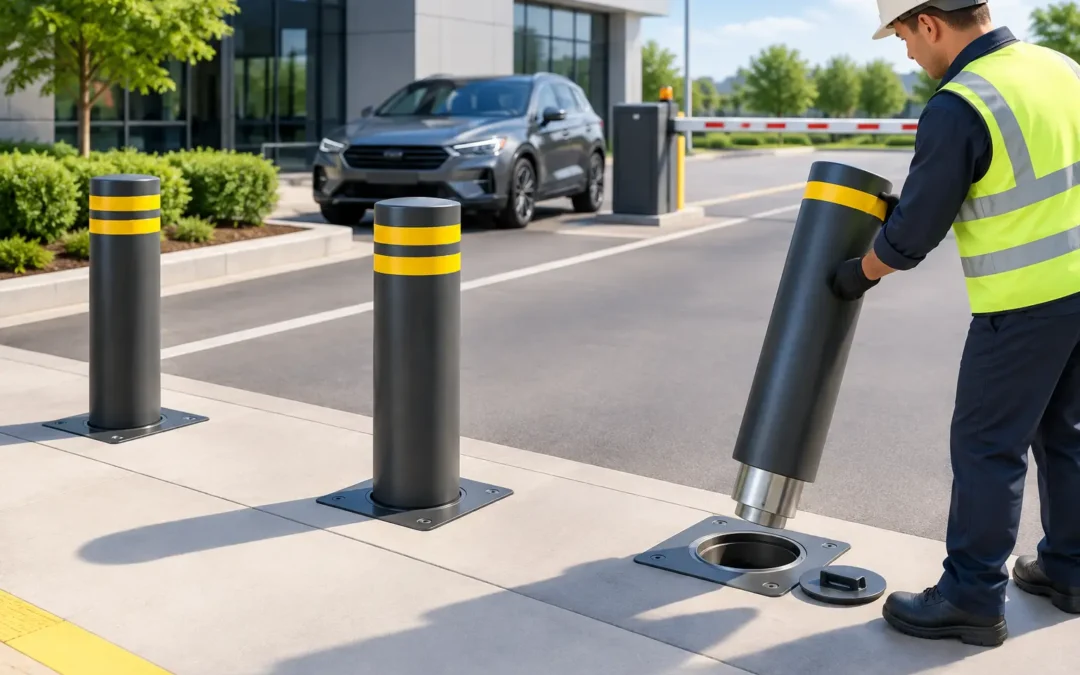
A delivery ute needs access at 7 am. By school drop-off, the same driveway needs to be closed to vehicles. Later, maintenance staff may need to enter again. Fixed removable bollards are designed for exactly this sort of site: they create a clear physical barrier where one permanent obstruction would get in the way.
For commercial properties, schools, strata complexes, industrial yards and sporting facilities, bollards can protect buildings, manage vehicle movement and support safer pedestrian areas. The right result depends on more than choosing a steel post. Bollard type, location, footing depth, locking method, access requirements and existing site conditions all need to be considered before installation begins.
What are fixed removable bollards?
The term covers two related solutions. Fixed bollards are permanently installed in position to prevent vehicle access or shield a vulnerable area. Removable bollards are secured into a ground socket or sleeve, then taken out when authorised vehicles need to pass through. They can be locked in place when access is restricted and stored safely when removed.
Using both types across one site is often the most practical approach. Fixed bollards can protect corners of buildings, services, gates, outdoor equipment or pedestrian paths. Removable units can close a driveway, fire access route, loading area or shared entry without permanently blocking it.
This flexibility is particularly useful where a site has competing demands. A school may need to prevent vehicles entering a courtyard during the day but allow groundskeeping equipment in after hours. A body corporate may want to stop unauthorised parking in a common area without making rubbish collection or emergency access difficult. An industrial site may need a secure boundary point that can still accommodate deliveries.
Where fixed removable bollards work best
Bollards are most effective when they solve a defined access or protection problem. Installing them simply because an area feels exposed can lead to poor spacing, unnecessary obstructions or a barrier that does not suit the people using the site.
At commercial and retail properties, they are commonly positioned near glazed shopfronts, roller doors, loading zones and entries where vehicles and pedestrians operate close together. In warehouse and industrial settings, they can mark no-go areas, protect machinery and control access through wide openings. For strata properties, removable bollards are often a sensible option for preventing unauthorised vehicle entry to shared driveways, visitor areas and landscaped spaces.
Schools, clubs and community facilities also benefit from clear access control. A removable bollard line can help close an oval gate, restrict vehicle movement near play areas or manage access to courts and clubrooms. The key is to plan for the legitimate users of the space, including emergency services, contractors and maintenance teams.
Fixed or removable: which is the better choice?
A fixed bollard is generally the better option where access should never be available. It has no lock to manage, no removable component to store and no risk of being left out of position after use. It suits permanent vehicle exclusion and areas requiring ongoing physical protection.
A removable bollard is the better choice when authorised access is required occasionally or regularly. It offers control without forcing a property owner to choose between an open driveway and a permanent barrier. The trade-off is operational: someone needs to hold the key or access tool, remove the unit correctly and return it to position when the vehicle has passed.
There are also semi-flexible arrangements. For example, fixed bollards may protect each side of an entry while one removable bollard closes the usable gap between them. This can reduce the number of removable components while still allowing a ute, small truck or maintenance vehicle through when needed.
The required opening width matters as much as the bollard itself. A gap that stops cars may still allow motorcycles or small equipment through. Conversely, placing bollards too widely apart can undermine the purpose of the installation. Site measurements and the type of vehicle being controlled should guide the final layout.
Choosing the right bollard specification
Not every bollard is intended to perform the same job. Decorative, traffic-control and asset-protection bollards may look similar at a glance, but their construction and installation requirements can differ considerably.
Material and finish should suit the setting. Galvanised steel is a practical choice for many external applications because it helps resist corrosion. Powder-coated finishes can be selected to suit a property’s colour scheme or improve visibility. In public-facing areas, visibility can be especially important, with contrasting finishes or reflective treatment helping drivers identify the barrier in low light.
Diameter, wall thickness and installation depth need to reflect the expected use. A bollard intended to guide vehicles away from a garden bed has different requirements from one positioned to protect a building corner or control a commercial access point. If the goal is meaningful vehicle impact protection, the installation must be specified for that purpose rather than treated as a standard landscaping job.
Locking arrangements also deserve attention. A removable bollard must be secure when installed but manageable for authorised users. Consider who will operate it, how often it will be moved, whether several staff members require access and what happens if keys are misplaced. The simplest system is often the most reliable, provided it meets the site’s security needs.
Installation details that affect performance
A bollard is only as dependable as the footing beneath it. Ground conditions, underground services, drainage, concrete thickness and nearby structures can all affect the installation method. Before digging, the site should be assessed to avoid services and ensure the bollard can be installed at the required depth.
For removable models, the ground sleeve needs to sit accurately and drain appropriately. Water, dirt and debris can collect inside an unused socket, making the bollard difficult to install or remove. A properly planned installation considers how the socket will be protected when the bollard is out, as well as where the removed bollard will be stored.
Positioning must also allow for safe pedestrian movement. Bollards placed carelessly can become trip hazards, create pinch points for prams or wheelchairs, or make a narrow footpath harder to use. At vehicle entries, they should be visible to drivers without compromising the turning path needed by authorised vehicles.
For sites with gates, fencing and access-control equipment, bollards should be planned as part of the overall layout. A well-positioned gate can be undermined by a gap beside it. In the same way, a bollard placed too close to a sliding gate track, swing path or intercom point can create a daily frustration. Looking at the whole entry before installation prevents expensive adjustments later.
Compliance and site planning
Australian Standards, building requirements and local conditions can influence a bollard project, particularly on commercial, education and public-access sites. Requirements may relate to pedestrian access, emergency egress, vehicle circulation, visibility and the particular level of protection required.
There is no single bollard specification that fits every property. A warehouse entrance, apartment driveway and school drop-off zone each need different thinking. For managed sites, it is also worth documenting who is authorised to remove bollards and when they must be returned to position. Clear procedures prevent the common problem of a removable barrier being left unsecured after a delivery or maintenance visit.
If bollards are being used to protect people or critical infrastructure, involve an experienced contractor early. Proper advice at the layout stage is far easier than relocating posts once concrete has cured or access problems have become apparent.
A practical approach to your bollard project
Start by identifying the risk or access issue you are trying to address. Is the priority stopping unauthorised parking, protecting a building, separating pedestrians from vehicles, securing an entry or keeping an emergency route available? From there, consider the vehicles that need access, the frequency of access and the space available for installation.
Photos, basic measurements and a clear description of how the area is used can help shape an accurate quote. On more complex sites, a visit is the best way to check levels, ground surfaces, services, gate movements and vehicle turning requirements.
Minster Fencing brings more than 40 years of fencing and access-control experience to Melbourne and Mornington Peninsula projects, with practical advice on fixed and removable bollard layouts, installation and finishes. A site-specific approach helps ensure the barrier works properly on day one and remains easy to manage long after the concrete has set.
The best bollard installation is one people barely need to think about: authorised vehicles can enter when they should, pedestrians have a clearer and safer space, and the property has a physical boundary where it matters. For advice tailored to your driveway, school, commercial premises or industrial site, arrange an obligation-free quote before choosing a standard off-the-shelf solution.