
A bollard can be a simple post in the ground, but its effect on how a site operates is significant. When choosing fixed versus removable access bollards, the key question is not which option is stronger in isolation. It is whether vehicles should be stopped permanently, admitted occasionally, or managed at different times of the day.
For Melbourne homes, schools, commercial premises and industrial sites, the wrong choice can create daily frustration. A fixed bollard may block a needed service vehicle. A removable bollard may be taken out too often, left unsecured or become impractical for staff to handle. A properly planned installation protects people and property while keeping legitimate access straightforward.
Fixed versus removable access bollards: the practical difference
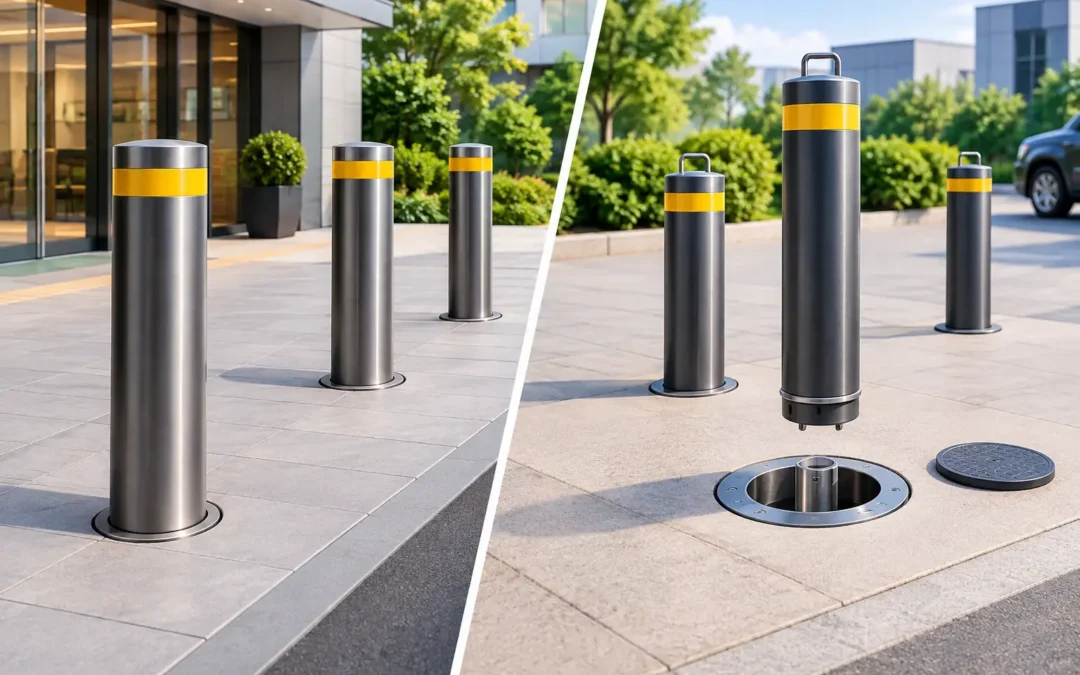
Fixed bollards are permanently installed in a set location. They are generally set into concrete footings and remain in place to provide ongoing vehicle exclusion, asset protection or pedestrian separation. They are suited to locations where access must not change, such as the edge of a shopfront, a building façade, a gas meter, a gate post or a pedestrian zone.
Removable bollards are designed to be lifted out when authorised vehicle access is required. The bollard fits into a ground socket or sleeve that is installed below ground level, then locks into place when in use. Once removed, a cover or cap can sit over the socket to reduce trip hazards and keep debris out.
Both systems can be manufactured in galvanised steel and finished to suit the site. The decision comes down to access requirements, the level of security required, the ground conditions and how reliably the people using the site will follow the operating process.
Choose fixed bollards where access must stay closed
Fixed bollards are the direct choice for permanent protection. They are commonly installed in front of roller doors that are no longer used, along footpaths beside vulnerable building areas, around plant and equipment, and at the ends of car parks where a vehicle could otherwise travel into a restricted area.
Their main advantage is consistency. There is no key to manage, no removable component to store and no chance that someone will leave an opening unprotected after a delivery. For sites with frequent public access, this simplicity is often as valuable as the physical barrier itself.
A fixed bollard can also support a clearer traffic layout. At a school, for example, permanent bollards can define a pedestrian-only space near classrooms or a drop-off area. At an industrial facility, they can shield electrical cabinets, loading-area corners and high-risk infrastructure from reversing vehicles.
The trade-off is obvious but worth considering early: once fixed bollards are installed, vehicles cannot pass through that point without removing and reinstating the bollards. If a ute, maintenance vehicle, emergency service vehicle or occasional delivery truck may need access, permanent posts may create a problem later.
Best applications for fixed bollards
Fixed bollards usually suit building protection, permanent traffic exclusion, pedestrian zones, restricted boundaries and areas where the public should never be able to drive. They also work well alongside tubular fencing, gates and chain-wire fencing where a complete perimeter-control system is required.
Foundation depth, concrete size and bollard spacing all matter. A post that is too widely spaced may allow a vehicle through, while a poorly positioned post can make turning movements difficult or affect accessible paths. Site-specific measurement is more reliable than selecting a standard layout from a plan alone.
Choose removable bollards where access changes
Removable bollards suit locations that need to be secure most of the time but open on selected occasions. Common examples include a commercial driveway used by delivery vehicles, a shared accessway, a school maintenance route, a sports club entrance or a residential side access leading to the rear yard.
When locked in position, a removable bollard performs the same access-control role as a fixed post. When removed, it creates an opening for vehicles, machinery or emergency access without the need to swing a gate across the driveway. This can be particularly useful where gate clearance is limited or a gate would obstruct a footpath or internal traffic route.
The benefit is flexibility, but flexibility needs management. Someone must have the right key, understand how to remove the bollard safely and put it back immediately after access is complete. The bollard also needs a secure storage location when it is out of the ground. On busy sites, these details should not be treated as an afterthought.
Where removable systems need more planning
Consider the likely frequency of use. If a bollard is removed once or twice a year for planned maintenance, a removable system is usually very practical. If staff remove it several times each day, a gate, boom gate or another access-control option may be more suitable.
The socket location also needs care. It should sit flush with the finished surface, drain appropriately and avoid creating a trip point. On sloping driveways, paved areas and sites with existing services, the installer needs to assess levels, drainage and safe excavation before work begins.
For strata properties and commercial facilities, clear responsibility is essential. Decide who holds keys, where removed bollards are kept and what happens when contractors require access. A secure system is only effective when it is reinstated every time.
Security is not just about the bollard
It is easy to focus on the post itself, yet overall security depends on the full opening. Bollard diameter, wall thickness, footing design, locking arrangement and spacing should match the risk of the site. A light-duty bollard may be appropriate for discouraging casual vehicle entry at a residential property. A site exposed to regular commercial traffic or deliberate unauthorised access may require a heavier-duty specification.
Spacing is particularly important. Bollards intended to stop cars should be placed so a vehicle cannot pass between them, while still allowing pedestrian access where required. If the opening must accommodate wheelchairs, prams, maintenance equipment or bins, those clearances should be considered before concrete is poured.
Do not assume a removable bollard is automatically less secure than a fixed one. A well-specified, locked removable system can provide strong access control for its intended use. However, fixed bollards eliminate the operational risk of an open socket or an absent bollard. For permanently sensitive areas, that distinction matters.
Consider people, vehicles and the surrounding site
The right bollard arrangement should make the site safer without making ordinary tasks harder. Start by observing who uses the area. This includes residents, visitors, staff, students, delivery drivers, contractors, cyclists and pedestrians, not only the vehicles you are trying to control.
Think through turning circles, reversing movements, waste collection, fire access, landscaping and future building works. A driveway may only need to admit a family car today, but a future renovation could require a concrete truck or excavator. A warehouse entry may need to remain clear for a forklift, pallet delivery or site maintenance.
Visibility is another practical point. Bollards near vehicle paths should be easy to see in poor light and wet conditions. A suitable finish, reflective treatment or careful location can help drivers identify the barrier before they reach it. Bollards should also be positioned to avoid creating an unexpected obstruction beside parking bays or gate openings.
Installation quality affects long-term performance
Whether bollards are fixed or removable, installation quality determines how well they hold up. Concrete footings need to suit the bollard type, soil conditions and expected loads. Posts must be plumb, evenly aligned and installed at a height that provides visible, useful protection.
Underground services must be checked before digging. This is especially relevant around existing driveways, commercial buildings and landscaped areas, where electrical cables, irrigation lines, drainage and communications services may be present. Cutting corners at this stage can turn a straightforward access-control job into an expensive repair.
Materials and installation should also suit the environment. Galvanised finishes are commonly chosen for long-term outdoor use, while powder-coated options can match surrounding fencing, gates or building colours. In coastal and high-exposure locations around the Mornington Peninsula, material selection deserves particular attention.
Minster Fencing can assess the access pattern, measure the opening and recommend a fixed, removable or combined bollard layout that suits the way your property actually operates. With more than 40 years of fencing experience and four generations of family ownership, the team provides practical, site-specific advice and professional installation.
A combined approach can be the better answer
Many properties do not need an either-or decision. A common arrangement is fixed bollards along the majority of a frontage, with one removable bollard creating a controlled service opening. This maintains permanent protection where it is needed while allowing authorised vehicles through at a single, manageable point.
A combined layout can also reduce cost and complexity compared with installing a full-width gate. It is particularly effective for narrow accessways, building side paths and entrances that only occasionally need to accommodate larger vehicles.
Before committing to a layout, stand at the proposed opening and picture a normal week on site. Consider the first delivery on a wet morning, a contractor arriving after hours and the need to move equipment during maintenance. The best bollard system is the one that keeps the boundary secure without becoming the obstacle everyone has to work around. Contact Minster Fencing for an obligation-free quote based on your Melbourne or Mornington Peninsula site.