
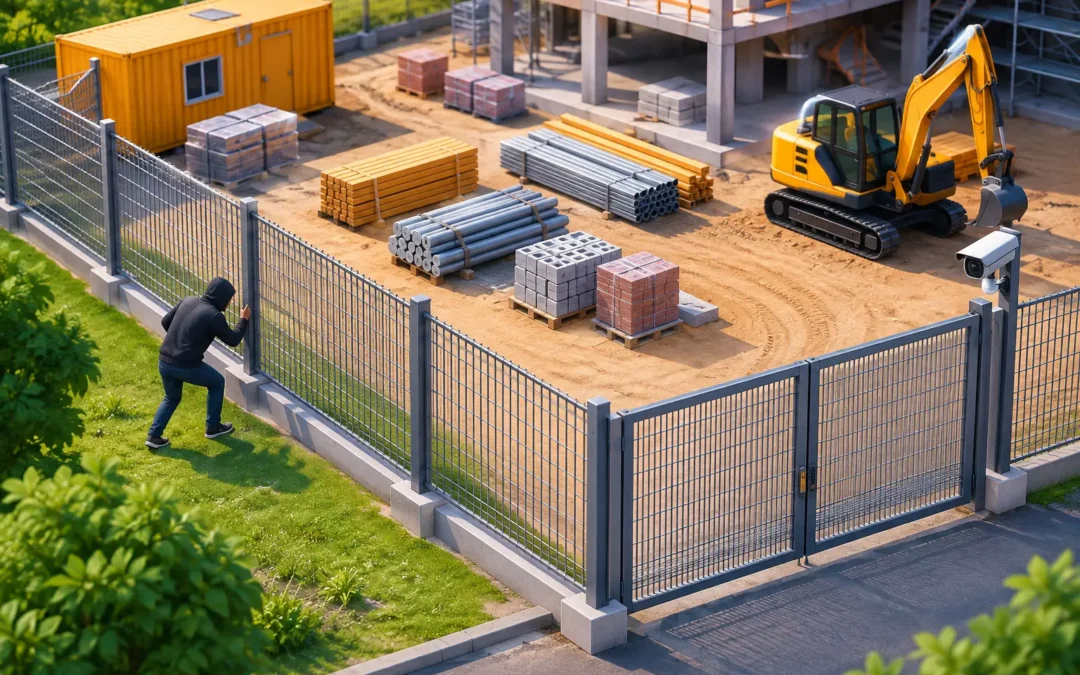
A stolen tool trailer, a cut chain on a temporary gate or missing copper can stop a job before the crew has unloaded the ute. So, can fencing reduce site theft? Yes, when it is designed as part of a practical perimeter and access-control plan. Fencing will not make a site impossible to enter, but it can make unauthorised entry harder, slower and far more visible.
For builders, facilities managers, school administrators and industrial operators, that delay matters. Opportunistic thieves generally look for an easy way in, a quick exit and limited chance of being seen. A well-specified fence, secure gate and controlled vehicle entry point disrupt all three.
Can fencing reduce site theft in practice?
The right fence establishes a clear boundary and removes the invitation created by an open, poorly defined or damaged perimeter. It tells visitors where they may enter, gives authorised people a predictable access point and makes climbing, cutting or driving onto the site more difficult.
Its value is not simply in the fence material. Security improves when the full line is considered: fence height, footing conditions, the space beneath the fence, corner treatment, gate hardware, vehicle access and the condition of adjoining boundaries. A high fence is of limited use if a gate can be lifted off its hinges or an unfenced gap behind a storage shed provides easy access.
Fencing is also a visible deterrent. A person considering entry can quickly assess whether a property has a maintained boundary, a lockable gate and a site owner who is paying attention. That does not deter every offender, particularly where valuables are clearly visible, but it can move a property out of the easy-target category.
Start with the risks on your site
A home renovation, a school, a commercial yard and an active construction site do not face the same risks. The best fencing solution depends on what needs protecting, how long the site will be exposed and who requires access each day.
On a construction site, portable tools, plant, fuel, cables and materials may be at risk after hours. The perimeter needs to withstand regular use, changing deliveries and potentially uneven ground. A commercial depot may need to prevent vehicle access as much as pedestrian entry, while still allowing trucks to move in and out efficiently. Schools and sporting facilities need secure boundaries that also suit daily public use, child safety and sightlines.
Before selecting a fence, identify the likely entry points. Look beyond the front gate. Side lanes, rear boundaries, shared driveways, retaining walls and low sections near bins or stored materials are common weak spots. Also consider what a person can see from outside. Stacked tools, pallets of materials and unsecured machinery can turn a manageable risk into an attractive target.
Match the fencing system to the level of security
Chain-link fencing remains a practical choice for many temporary and permanent sites. It is cost-effective across larger perimeters, provides visibility and can be installed with suitable gates for pedestrian and vehicle access. For lower-risk projects, it can clearly define the site and discourage casual entry. For higher-risk locations, heavier chain-wire specifications, secure fittings and appropriate gate arrangements can provide a more difficult barrier to defeat.
Welded mesh fencing offers a firmer, more rigid panel system with a clean commercial finish. Its close mesh pattern can make climbing and cutting more difficult than lighter fencing options, depending on the product selected. It suits commercial properties, schools, storage areas and industrial sites where appearance, visibility and boundary strength all matter.
Tubular fencing is often selected where a property needs security without a closed-off appearance. It is well suited to frontages, schools, car parks and areas where passive surveillance from the street or nearby buildings is useful. The spacing, height and gate design should be considered carefully, particularly around access points.
For sites needing a higher level of perimeter protection, palisade fencing can be an appropriate option. Its vertical steel pales and more challenging climbing profile make it suitable for industrial facilities, service yards and other locations where unauthorised access would have serious consequences.
No single product is right for every job. A warehouse boundary may need palisade or welded mesh fencing, while a short-term building project may be better served by a secure chain-link perimeter with well-managed gates. The fence should suit the threat, the budget, the site layout and the expected service life.
Gates are where security is won or lost
Most authorised and unauthorised movement happens through a gate. A good perimeter fence needs a gate system that is equally capable. Sliding gates, swing gates and pedestrian gates should be sized for actual site traffic, installed accurately and fitted with hardware suited to their weight and use.
A gate that drags, will not latch properly or is routinely left open soon becomes a security gap. Consider how it will be locked after hours, who holds keys or access credentials and whether deliveries can be managed without leaving the entire site open. On sites with vehicle risks, fixed or removable bollards can help protect gateways, roller doors and vulnerable frontage areas from forced vehicle access.
For high-value compounds, separate pedestrian and vehicle entry can improve control. It limits the number of times a wide vehicle gate is opened and gives staff, contractors and visitors a clearer route onto the property.
Installation details make a real difference
Security fencing relies on more than panels and posts. Posts need to be set to suit the ground conditions and fence type. Changes in level must be handled without leaving climbable or crawlable gaps. Corners and ends require proper bracing, and gates need sufficient clearance to operate without compromising the boundary.
A tidy installation is also easier to inspect and maintain. When fence lines are straight, gates close properly and access areas are clearly defined, damage is easier to spot. Small faults should be addressed early. A loose fitting, bent panel or damaged padlock signals that a perimeter may be easier to breach again.
Where relevant, fencing materials and installation should comply with applicable Australian Standards and project requirements. This is especially important for schools, public-facing facilities, pools, sporting grounds and commercial projects with defined specifications. Compliance supports safety and performance, but it should not be treated as a substitute for a site-specific security assessment.
Fencing works best with sensible site habits
A fence is a physical layer of protection, not a complete security system. Its effect is much stronger when the site is organised around it. Keep valuable items away from the boundary where possible, remove loose materials at the end of the day and avoid creating climbing aids such as stacked pallets beside the fence.
Lighting can improve visibility around gates, storage areas and blind corners. Cameras and alarms may provide another useful layer, particularly for remote, high-value or repeatedly targeted sites. Signage can establish access rules and warn that entry is restricted, although signs alone are not a barrier.
Just as importantly, make security part of the daily close-down routine. Check that gates are locked, vehicles are secured, keys are accounted for and any temporary access points have been closed. On a busy project, responsibility should be clear rather than assumed.
When a fence may not be enough
If theft is being carried out by organised offenders, or if the site contains expensive machinery, fuel, copper or high-value stock, standard perimeter fencing may need reinforcement through monitored security measures, stronger gate control or protected storage cages. A fencing contractor can identify perimeter weaknesses, but a broader security plan may also require input from your insurer, security provider or project manager.
Likewise, a fence that blocks sightlines can sometimes create concealed areas. In these situations, an open-style tubular or mesh system, supported by lighting and cameras, may be more useful than a solid screen. Security is about reducing opportunity, not simply adding more steel.
With more than 40 years of fencing experience across Melbourne and the Mornington Peninsula, Minster Fencing can assess the practical demands of your site and recommend a perimeter that suits how it operates. A site-specific quote is the sensible place to start: walk the boundary, identify the weak points and build protection around the access routes that matter most.