
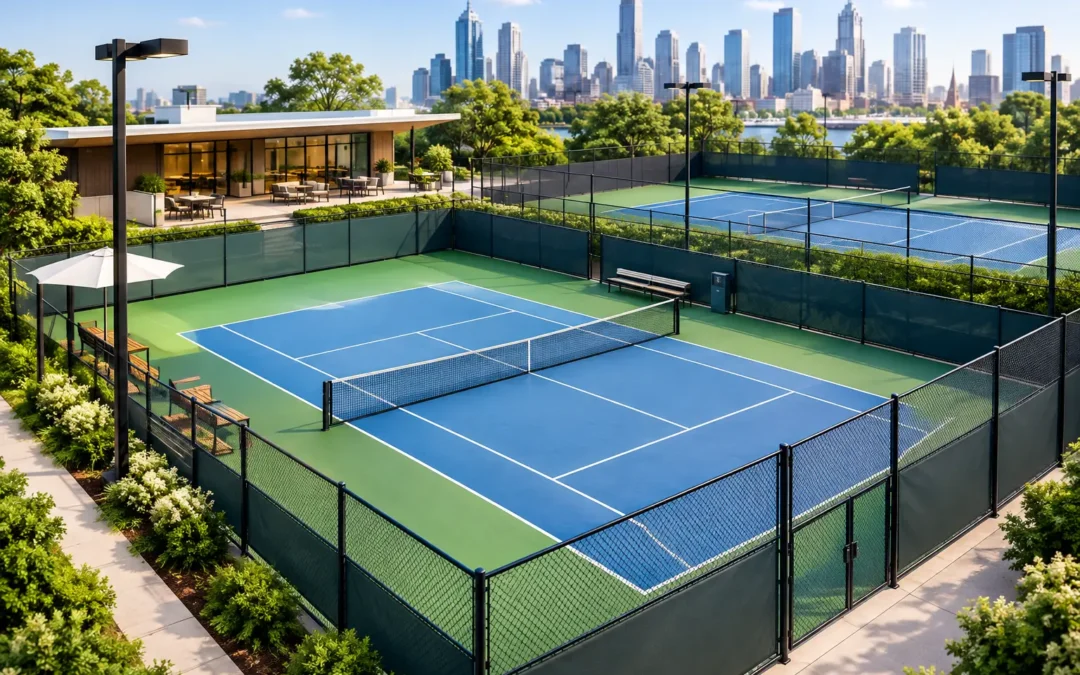
A tennis ball that leaves the court does more than interrupt a rally. At a busy club, it can enter a neighbouring court, roll towards a car park, delay coaching sessions or create a safety issue near pedestrian areas. The best fencing for tennis clubs keeps play contained, protects spectators and nearby property, and stands up to constant use without making the court feel closed in.
For Melbourne clubs, the right choice is rarely just a matter of selecting a fence height. Court layout, exposure to wind, nearby roads, junior programs, access requirements and the condition of existing footings all affect the final specification. A fencing system should be planned as part of the playing environment, not treated as an afterthought around it.
What the best fencing for tennis clubs needs to do
Tennis court fencing has several jobs at once. It needs to stop balls reliably, define the court perimeter, provide secure access when the club is closed and allow clear sightlines for players, coaches and spectators. It also needs to cope with repeated ball impact, people leaning on it, gates opening and closing, and Melbourne’s changeable weather.
For most clubs, chain-link or chain-wire fencing remains the practical starting point. It is durable, cost-effective across large court areas and provides excellent visibility. The open mesh also allows air to move through the enclosure, which reduces wind pressure compared with solid fencing.
The best system depends on how the court is used. A private residential court has different demands from a multi-court club with coaching, competition, public access and adjoining facilities. Clubs should also consider the long-term cost of repairs. A low initial price can become expensive if posts move, wire loosens or gates need frequent attention.
Chain-wire fencing for court enclosures
Galvanised chain-wire fencing is widely used for tennis courts because it offers a proven balance of containment, strength and visibility. When installed with correctly sized posts, rails, tension wire and fittings, it creates a flexible but dependable boundary that can handle regular impact.
For clubs that want a more finished appearance, black or green PVC-coated chain-wire can sit more quietly within landscaped grounds. Dark mesh is often easier to see through than bright galvanised wire, while reducing glare around the court. The coating can also provide an added layer of protection in exposed locations, although it should be selected as part of a quality system rather than used to compensate for undersized materials.
Mesh aperture and wire gauge matter. A mesh that is too open can allow balls to pass through or become caught at speed, while light-gauge wire may not hold its tension over time. The right combination will depend on court use, fence height and the span between posts. This is where a site-specific recommendation is more useful than a one-size-fits-all product selection.
Court height is not the whole answer
A typical tennis court enclosure often uses higher fencing behind the baselines and lower fencing along the sidelines. This reflects how balls travel during play. Higher ends help contain lobs, serves and practice shots, while lower side fencing maintains visibility and access between courts.
The final heights should be based on the court configuration and surrounding risks. Courts beside roads, shared driveways, playgrounds or neighbouring homes may need greater containment than courts within a larger sporting reserve. Where multiple courts sit together, internal dividing fences can be designed to manage ball movement without making the venue feel cramped.
Higher fencing also increases wind loading on the structure. The taller the enclosure, the more important it is to match the posts, rails, footings and bracing to the site conditions. This is particularly relevant for open grounds and coastal or bayside areas where wind exposure can be significant.
Posts, footings and tension make the difference
The wire mesh is the visible part of a tennis fence, but the supporting structure determines how well it performs over time. Loose chain-wire, leaning posts and sagging gates are usually signs that the system was not designed or installed as a complete structure.
Terminal posts at corners, ends and gate openings carry more load than line posts. They need suitable bracing and secure concrete footings to maintain tension across each run of mesh. Line posts should be spaced appropriately for the fence height and site conditions, while top rails and tensioning components help keep the fence straight and stable.
Existing courts can create added installation challenges. Underground services, old concrete edges, drainage lines, tree roots and inconsistent ground conditions need to be checked before work begins. A careful site measure also identifies where fence lines need to work around light poles, seating, retaining walls or clubhouse access.
Where materials and installation are specified for the site and completed to relevant Australian Standards, clubs are better placed to receive a fence that performs as intended. Compliance is not just a box to tick. It supports safe access, structural reliability and a more professional result.
Gates should support safe, easy court access
Gates are often the first part of a court fence to show wear. They are used by players carrying racquets and bags, coaches moving equipment, contractors bringing in maintenance gear and grounds staff using machinery. A poorly positioned or lightly built gate quickly becomes an inconvenience.
Pedestrian gates should be wide enough for comfortable daily use and fitted with durable hinges, latches and closing hardware. Double gates may be needed where court maintenance equipment, surface-treatment machinery or emergency access requires a wider opening. Gate posts need proper support, as their movement can affect both security and the alignment of adjacent fencing.
The gate location should be considered alongside player flow. On a multi-court site, practical access points reduce people cutting across playing areas or propping gates open. If the club uses key, fob or coded access, the latch and gate arrangement should work with that system from the outset.
Windbreaks and privacy screens need careful planning
Windbreak fabric can make a court more comfortable and improve the playing experience, especially on exposed sites. It can also provide privacy where courts face homes, public paths or nearby facilities. However, a screen changes how the fence handles wind.
Even semi-permeable shade cloth or windbreak material adds load to posts, rails and footings. The greater the coverage, the more carefully the structure needs to be assessed. Clubs should avoid attaching screens to an existing fence without confirming it can carry the extra load, particularly if the fence is older or already showing signs of movement.
There is also a practical trade-off. Dense screening can reduce wind and visual distractions, but it may restrict airflow, collect debris and make sections of the court feel darker. A partial screen, selected for the prevailing wind direction, can sometimes deliver a better result than covering every fence line.
Planning a replacement or new court fence
Before requesting quotes, a club committee or facilities manager should identify the problems the project needs to solve. It may be ball containment, damaged mesh, uncontrolled access, poor gate operation, wind exposure or a need to improve presentation before competition season. Clear priorities help a fencing contractor recommend the right system instead of simply matching what is already there.
It is also worth planning for the work around court bookings and member access. Replacement fencing may require temporary closures, particularly when old footings are removed, posts are installed or gates are being changed. A contractor experienced in sporting-ground fencing can stage the work sensibly, keep the site tidy and communicate clearly about what will be unavailable and when.
Ask whether the quote includes removal and disposal of old fencing, new posts and footings, mesh, rails, tensioning, gates, access hardware and any required finishing works. Comparing like-for-like scopes is essential. A cheaper figure may exclude the components that make the fence durable.
At Minster Fencing, our team brings more than 40 years of fencing experience to tennis courts and sporting grounds across Melbourne and the Mornington Peninsula. As a fourth-generation family business, we understand that clubs need reliable advice, tidy workmanship and an installation that fits the way their facilities operate.
A well-planned tennis fence should let members focus on the next point, not on chasing balls through a gap or working around a gate that will not close. A site inspection and obligation-free quote can turn those day-to-day frustrations into a court enclosure built for years of play.