
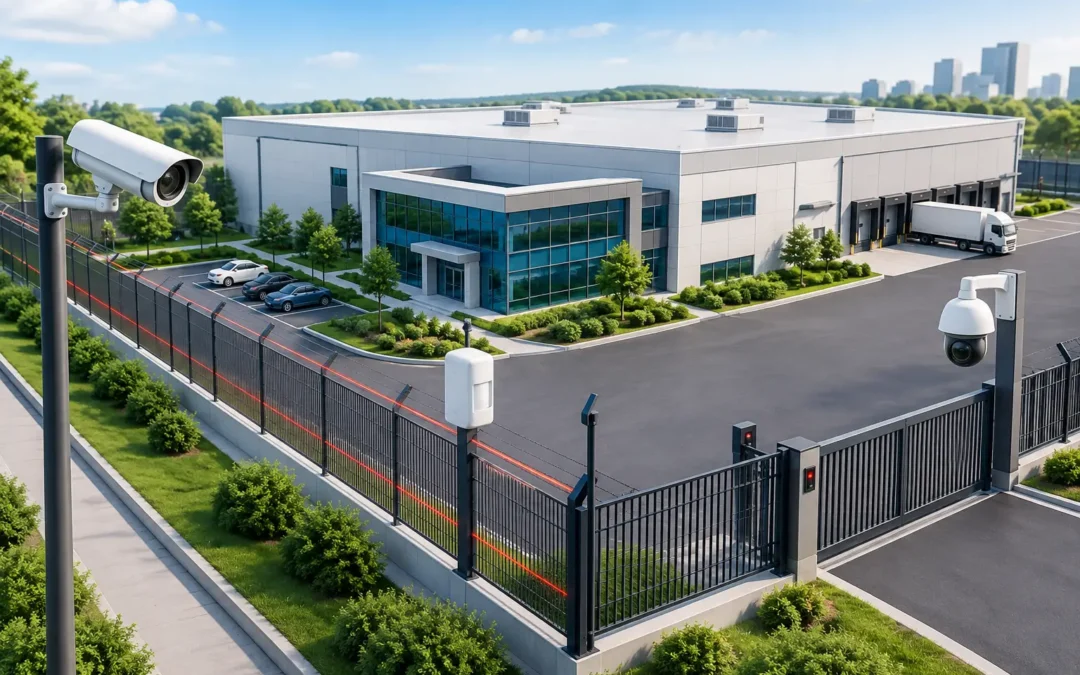
A damaged gate, an open loading area or a fence that can be climbed in seconds can turn a normal worksite into an expensive security problem. The top commercial perimeter security systems do more than mark a boundary. They control access, discourage unauthorised entry and give site managers a practical first layer of protection around people, equipment and stock.
For commercial properties across Melbourne and the Mornington Peninsula, the right answer depends on what needs protecting, how the site operates and the level of visibility required. A school has different priorities from a warehouse, while a sporting club, construction site and industrial yard each need their own balance of security, durability and access.
What a commercial perimeter system needs to do
A perimeter system should suit the risk, not simply be the tallest fence available. It needs to establish a clear boundary, withstand daily use and weather, and work with the way vehicles, staff, visitors and deliveries enter the property.
For some sites, the priority is preventing casual access after hours. For others, it is restricting vehicle access, protecting high-value materials or directing visitors to a controlled entry point. Visibility matters too. A solid screen fence can provide privacy, but it may create hiding places around a boundary. Open-style fencing can improve sightlines for staff, security patrols and cameras.
The best outcome usually combines fencing, gates and vehicle-control measures as one coordinated system. It is far more effective to plan these elements together than to add a lock, bollard or gate after the fence has been installed.
Top commercial perimeter security systems for local sites
Chain wire fencing for large boundaries
Chain wire fencing remains a practical choice for warehouses, industrial yards, storage areas, schools, construction compounds and sporting grounds. It is cost-effective over long distances, quick to install on suitable ground and allows clear visibility across the site.
Security-grade chain wire systems can be specified with heavier fabric, stronger posts, top rails, barbed wire or other anti-climb measures where appropriate. The fence height, mesh type and post footing all affect performance. A light-duty chain wire fence may suit a temporary compound, while a busy industrial facility needs a more substantial design that can cope with ongoing pressure and attempted intrusion.
Chain wire is not always the right choice for a property seeking a polished street-facing appearance or a high level of privacy. In those cases, tubular, welded mesh or panel fencing may be better suited.
Welded mesh fencing for strength and visibility
Welded mesh fencing is widely used where a business wants a clean, modern perimeter with stronger anti-climb characteristics than standard chain wire. Its rigid panels create a neat finish and can be installed at heights suited to commercial and institutional applications.
The narrow mesh openings make it harder to gain a foothold, while the open design maintains visibility. This makes welded mesh a sound option for schools, utility areas, commercial facilities, car parks and sites using CCTV. It can also be integrated with matching pedestrian gates and vehicle gates for a consistent boundary line.
The trade-off is cost. Welded mesh generally requires a greater upfront investment than basic chain wire, particularly on uneven sites or where custom-height panels and specialised gates are required. Its durability and appearance can make that investment worthwhile for a permanent, high-traffic site.
Tubular steel fencing for controlled access areas
Tubular fencing suits commercial frontages, education facilities, strata properties and entry areas where presentation matters alongside security. Steel pickets and rails provide a formal appearance, and the spacing between pickets can be selected to reduce climbability while keeping the property visible from the street.
A well-designed tubular fence is particularly effective when paired with self-closing pedestrian gates, keypad access or an automated sliding gate. It can clearly separate public areas from staff-only zones without making the site feel closed off.
For higher-risk industrial sites, tubular fencing may need added security features or a different system altogether. Its effectiveness depends on fence height, picket profile, rail strength and the gate hardware used. A quality fence can still be undermined by an easily forced gate latch or poorly installed posts.
Palisade fencing for higher-security boundaries
Palisade fencing is designed for sites where a strong visual deterrent is needed. The steel pales, often with pointed or shaped tops, create a difficult barrier to climb or cut through. It is commonly considered for industrial facilities, service yards, infrastructure sites and properties holding valuable plant or materials.
Palisade fencing provides an imposing boundary while allowing visibility into and out of the site. That visibility helps security cameras and patrols, but it also means it offers little privacy. It is generally a more specialised system and should be designed around the site layout, ground conditions, gate locations and relevant safety requirements.
Security gates that match the fence
A perimeter is only as secure as its entry points. Sliding gates, swing gates and pedestrian gates should be chosen according to vehicle movements, available space and the frequency of access. A sliding gate often suits a busy commercial driveway where a swing gate would obstruct internal circulation. Swing gates can work well for lower-traffic access points with sufficient clearance.
Gate automation can improve control over who enters and when, particularly where staff use remotes, keypads, swipe access or intercom systems. However, automation needs careful planning. The gate must have safe operating clearances, reliable foundations and appropriate safety devices. It should also allow for manual access if there is a power outage or equipment fault.
Bollards for vehicle protection
Fixed or removable bollards protect building entries, roller doors, plant, pedestrian zones and restricted vehicle areas. They are often overlooked until a reversing vehicle damages a wall, gate track or service point.
Fixed bollards provide permanent protection where vehicles should never enter. Removable bollards are useful where occasional authorised access is needed, such as a service lane, emergency route or shared driveway. Their placement should be planned carefully so they protect the intended asset without creating a hazard for drivers or pedestrians.
Choosing the right level of security
The most suitable system starts with a site assessment. Consider what is stored on site, whether the property is occupied after hours, where intruders could gain access and how staff and deliveries move through the boundary each day. A rear laneway, poorly lit side boundary or open loading dock may present a greater risk than the front fence.
It is also worth considering future needs. A business may later add cameras, access control, extra parking or a new storage area. Planning conduits, gate locations and clear sightlines early can prevent costly alterations later.
Materials and installation should comply with relevant Australian Standards and suit local conditions. Coastal exposure, reactive soil, sloping ground and high-use gates all influence the specification. The cheapest fence on a quotation can become the most expensive if posts move, gates sag or components fail under everyday use.
Installation quality is part of the system
Commercial fencing is not simply a product delivered to site. Set-out, post depth, footing design, panel alignment, gate adjustment and finish quality all influence security and service life. Poorly aligned fencing can leave gaps; inadequate gate hardware can cause access issues; rushed excavation can affect stability.
Experienced installers will check levels, underground services, drainage considerations and practical access before work begins. They should also coordinate the fence line with existing structures, retaining walls, footpaths, driveways and landscaping. For operational sites, installation staging matters as well. Maintaining a secure boundary while work is underway is often essential.
Minster Fencing brings more than 40 years of fencing experience to commercial, industrial, education and sporting projects, with systems tailored to the site rather than a one-size-fits-all product. Clear quoting, dependable scheduling and a tidy completed job matter just as much as the materials selected.
A practical starting point is to walk the boundary at the time the site is most exposed – often early morning, after hours or when deliveries are arriving. The weak points become clearer then, and a site-specific fencing and gate plan can be built around how the property really operates. Contact a qualified local fencing contractor for an obligation-free quote that accounts for security, access, appearance and long-term performance.