A Colorbond fence can look simple from the street, but the profile chosen for its panels has a major effect on the finished boundary. Selecting custom Colorbond fence profiles is about more than choosing a colour. It involves working out how much privacy the site needs, how the fence will sit across changing ground levels, what wind loads it may face and how the design will work with the home, garden or commercial premises.
For Melbourne properties, the right answer is rarely a standard, one-size-fits-all fence. A narrow side boundary, a coastal block on the Mornington Peninsula and an exposed commercial site can all require different profile, post and installation decisions. Getting these details right before work starts helps deliver a neat, durable result that suits the site.
Start with the job the fence needs to do
Before comparing panel profiles, decide what the fence must achieve. Most residential boundaries need reliable privacy and a tidy finish, while commercial and industrial sites may place more emphasis on security, access control and long runs of fencing that need to remain straight and stable. A fence around a school, sporting facility or shared property also needs to account for public access, maintenance and the way people move around the site.
Height is usually the first practical question. A higher fence may improve screening, but it can also be subject to council requirements, planning controls, overlooking considerations and neighbour discussions. Where retaining is involved, the retaining wall and fence should be planned as one system rather than treated as separate jobs. Loading a fence onto a wall that has not been designed for it can create problems later.
It is also worth considering what sits on either side of the boundary. Air-conditioning units, bins, garden beds, driveways, gates and service paths all affect where posts can be installed and how accessible the fence will be once complete.
What a fence profile changes
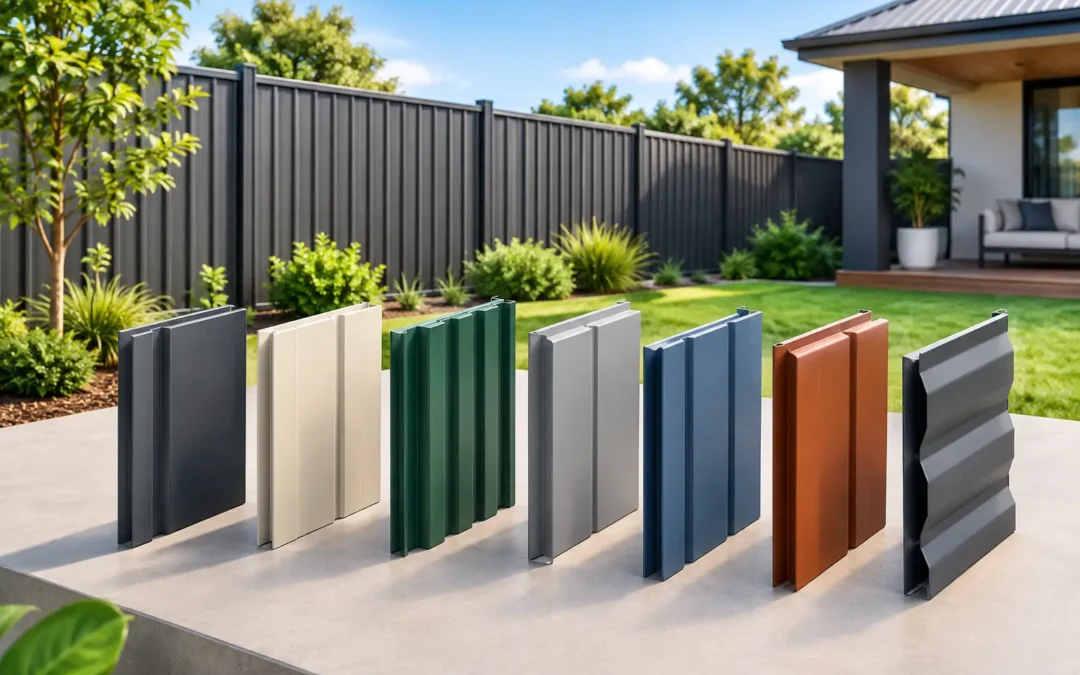
The profile is the shape and visual pattern formed by the steel sheets or panels. It influences the appearance of the fence, but it also affects how light, shadow and minor surface marks are seen across a long run. A strongly ribbed profile can create more visual definition, while a flatter or more subtle profile generally gives a cleaner, more contemporary look.
Neither option is automatically better. A prominent profile can suit a traditional home, a practical rear boundary or a site where the fence needs visual strength. A simpler profile may sit more comfortably beside modern cladding, rendered walls and clean-lined landscaping. On a long boundary, ask to see a realistic sample or completed example if possible. What looks understated in a small colour sample can appear very different across 30 metres of fencing.
Custom work may also include the way panels are set out, the use of framed sections, feature infills, stepped heights or coordinated gates. These choices should support the overall function of the fence, not just create detail for its own sake. Too many transitions or mismatched materials can make a boundary look busy and add unnecessary maintenance points.
Consider both sides of the boundary
For many dividing fences, the visual outcome matters to neighbours on both sides. Standard Colorbond-style fencing commonly provides a consistent finished appearance to each property, but custom details, gates and adjoining structures can change the view from either side.
Discuss the fence line early, particularly where there are existing trees, old fences, retaining walls or drainage issues. Clear agreement on the boundary position, height and finish reduces the chance of costly adjustments once posts are in the ground.
Match the profile to the property style and colour scheme
Colour is often the most visible decision, yet it should be made alongside the profile and surrounding materials. A dark colour can give a crisp, modern edge and help a fence recede behind planting. It may also show dust more readily in some locations and absorb more heat in exposed areas. Lighter tones can soften a boundary and work well beside weatherboard, pale brick or coastal-style landscaping, though they may show splashes and marks differently.
Look beyond the fence itself. Roof colour, guttering, window frames, garage doors, paving and retaining materials provide useful reference points. Matching every element exactly is not always necessary. Often, a related tone creates a more considered result than an exact match.
On smaller blocks, a profile with a calmer visual rhythm can prevent the boundary from feeling too dominant. On larger properties or commercial sites, a stronger profile and darker finish may better define the perimeter. The location of the fence matters too. A highly visible front-side boundary deserves different consideration from a rear fence largely screened by established planting.
Account for levels, wind and ground conditions
A well-selected profile will not compensate for poor set-out or inadequate footing depth. The installation method is just as important as the panel style, particularly on Melbourne sites with sloping ground, reactive soils or exposure to strong winds.
Where ground levels change, fencing can be stepped in defined increments or raked to follow the slope. Stepping produces level panel sections and is often the practical choice for more pronounced falls. Raking can create a closer line to the ground on gentler slopes, but its suitability depends on the panel system, site geometry and desired finish. A site inspection is the best way to determine which approach will look right and provide appropriate clearance.
Wind exposure needs careful attention on open blocks, elevated sites and properties near the coast. Solid fencing catches more wind than open-style fencing, so post spacing, footing size, rail arrangement and overall construction must be suited to the conditions. Cutting corners on these unseen components can lead to movement, leaning posts or damaged panels after severe weather.
Drainage is another detail that should not be overlooked. Fences should not trap runoff against buildings, direct water onto neighbouring land or interfere with existing drainage paths. If the new fence replaces an older structure, the team should also check for services before digging. Gas, power, water and communications services may affect post locations and construction planning.
Include gates and transitions in the original design
A pedestrian gate or vehicle access point should be designed with the fence, rather than added after the panels are installed. The gate needs suitable clearance, practical latch placement and posts capable of handling repeated use. For driveways, think about the space required for vehicles to enter without obstructing a footpath, road or internal accessway.
Transitions deserve the same care. A Colorbond boundary may meet tubular fencing, brickwork, timber cladding, retaining walls or an existing side gate. Custom flashings, trims and post positions can make these junctions look intentional instead of improvised. This is particularly valuable when updating only part of a property or working around landscaping that will remain in place.
For commercial and institutional sites, gates may need to accommodate delivery vehicles, maintenance equipment or controlled access. In those cases, the chosen fence profile should be considered alongside the wider perimeter system, including bollards, pedestrian access and security fencing where required.
Check requirements before finalising the profile
A fence is a permanent site feature, so it pays to confirm requirements before materials are ordered. Local council rules, estate guidelines, planning permits, heritage controls and body corporate requirements can influence fence height, location and appearance. Pool fencing is a separate safety system with its own strict requirements and should never be assumed to be covered by a standard boundary fence design.
For shared boundaries, practical communication with adjoining owners remains essential. Clarify the proposed line, height, material and any contribution arrangements before the old fence comes down. If there is uncertainty about the legal boundary, seek appropriate advice before installation rather than relying on assumptions based on an existing fence line.
Quality materials and workmanship should also be selected with relevant Australian Standards and the site application in mind. This matters most where fencing forms part of a security perimeter, protects public areas or must perform in demanding conditions.
Choosing custom Colorbond fence profiles with confidence
The best profile is the one that suits the site as well as the style of the property. It should provide the privacy or perimeter definition required, handle local conditions and connect neatly with gates, levels and adjoining structures. A low-cost choice that ignores wind exposure, drainage or awkward transitions can become expensive to correct.
With more than 40 years of fencing experience, Minster Fencing can inspect the site, discuss practical profile and finish options, and provide a clear, obligation-free quote for custom Colorbond fencing across Melbourne and the Mornington Peninsula. Bring photos of the property, any estate requirements and an idea of the outcome you want. A proper site conversation before installation is the most useful step towards a fence that looks right from day one and continues to do its job for years.