
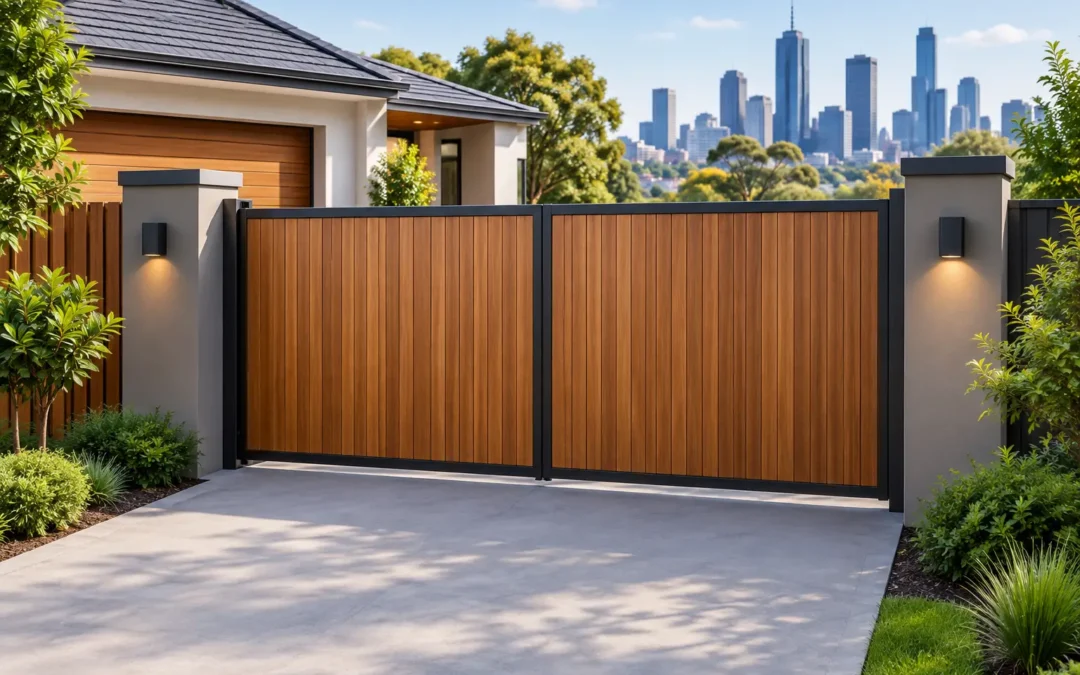
A driveway gate has to do more than look good from the street. It needs to open reliably in wind and rain, handle daily vehicle access, suit the slope and width of the entry, and provide a secure boundary when the property is unattended. Timber clad driveway gates are a strong choice where homeowners want the warmth of timber without relying on a heavy, all-timber gate structure.
The best result is usually a purpose-built steel gate frame with timber cladding selected to suit the home, fencing and exposure to the elements. This approach gives the gate the structural strength needed for regular operation while allowing the timber face to create a more considered, architectural finish.
Why timber clad driveway gates suit Melbourne homes
Timber brings character that powder-coated metal alone cannot always provide. It can soften the look of a rendered façade, sit naturally alongside brickwork, or tie a new gate into existing timber fencing, decking and landscaping. Horizontal boards can make a narrow frontage feel wider, while vertical battens often suit taller, more formal entries.
For Melbourne and Mornington Peninsula properties, the practical benefit is in the construction behind the timber. A correctly fabricated metal frame can be designed around the gate span, weight, hinges, latch arrangement and automation requirements. The cladding is then fixed to a stable structure rather than being expected to carry the full load of the gate.
That distinction matters. Driveway gates are subject to repeated movement, vibration and changing weather conditions. If the frame, posts and hardware are undersized, even quality timber can end up looking uneven as the gate begins to sag or bind.
Start with the way the gate will be used
The right gate layout depends on the site, not simply the preferred look. A driveway that opens directly onto a busy street may need a sliding gate so no leaf swings towards the footpath or road. A wider, level entry with adequate internal clearance may suit double swing gates. For a tight site, a cantilever sliding gate can be considered where ground conditions and available run-back space allow.
Before fabrication, it is worth confirming who will use the gate and how often. A gate used once or twice a day has different demands from one serving multiple vehicles, a strata complex, a trade yard or a school service entry. Automation, keypad access, intercoms, remotes and pedestrian access should be planned early, rather than added after the gate is installed.
Sliding gates
Sliding gates are popular for driveway entries because they can secure a broad opening without requiring clearance for swinging leaves. They work well where there is usable space along the fence line for the gate to travel. The track, rollers, guides and motor arrangement need to be matched to the weight of the clad gate and kept clear of gravel, leaves and built-up dirt.
Swing gates
Swing gates provide a classic entrance and can be an excellent option for residential properties. They do, however, need enough room inside the boundary to operate safely. The posts, hinges and drop bolts must be selected for the finished gate weight, particularly where solid or wide timber boards are used.
Choose cladding for appearance and maintenance
Not all timber products will perform the same way outdoors. The selected species, board profile, fixing method and coating system all influence the final appearance and the level of ongoing care required.
Hardwood cladding can provide a rich natural finish and strong visual appeal, but it is generally heavier and may need regular cleaning, oiling or recoating to maintain its colour. Left untreated, many timbers will weather to a grey tone. Some owners prefer that natural change; others want to retain the original colour and should allow for maintenance from the outset.
Treated pine is often a more economical option and can be painted or stained, although it may not deliver the same refined grain pattern as hardwood. Composite or timber-look products can also suit some projects where low maintenance is the priority, though the appearance and heat movement should be assessed before specifying them on a full driveway gate.
Board spacing is another decision with practical consequences. Small gaps between battens can reduce wind pressure and allow some light through, while a fully closed design gives greater privacy. On exposed blocks, a solid gate can catch significant wind, so the frame, posts and footing design need to account for that load.
The frame and posts do the hard work
A timber-clad gate should not be treated as a simple timber fencing panel on hinges. The steelwork and foundations are what keep the gate true over time.
A professional installation considers the overall gate weight, opening width, wind exposure, soil conditions, post depth, footing size and the location of motors or access controls. Steel components should be suitably protected for outdoor conditions, and dissimilar materials need to be detailed carefully to avoid staining, corrosion or premature deterioration around fixings.
Good drainage also matters. Timber cladding should not sit in standing water or directly against soil. Clearance beneath the gate helps it operate over changing ground levels and allows water, leaves and small debris to pass through. On sloping driveways, the gate configuration may need to be adjusted so it can open without scraping the surface.
Automation needs proper planning
An automated timber clad driveway gate adds convenience, but it introduces safety, electrical and maintenance considerations. The motor must be rated for the gate type and load, and the gate needs suitable stops, guides and safety devices. A heavy gate with a motor chosen only on price is likely to become slow, noisy or unreliable.
The location of power should be decided before the footings and conduit runs are completed. It is also sensible to consider manual release access for a power outage, remote range, keypad position, vehicle detection and a separate pedestrian gate where people regularly enter on foot.
Automated systems should be installed with applicable Australian Standards, manufacturer requirements and site safety conditions in mind. This is particularly important around shared driveways, commercial premises, schools and areas where children or visitors may be near the gate.
Match the gate to the surrounding fencing
The strongest driveway entrances feel connected to the rest of the boundary. Timber cladding can be continued onto pedestrian gates, screening panels or feature fencing, while tubular, welded mesh or Colorbond fencing can provide the security and enclosure needed along the remaining boundary.
There is no need for every section to use the same material. A timber-clad front gate may sit well with dark powder-coated steel posts and side fencing, creating a clean contrast while keeping the timber as the focal point. The important part is aligning the timber direction, spacing, frame colour and gate height so the frontage looks intentional.
For commercial and multi-residential sites, the same approach can be used with a stronger focus on access control, visibility and durability. Timber cladding may suit the public-facing entry, while more functional fencing systems manage the larger perimeter.
What ongoing care should you expect?
A well-built gate still needs routine attention. Timber should be checked periodically for movement, surface wear, loose fixings and coating condition. Hinges, rollers, tracks and latches need cleaning and adjustment as required. Automated gates should be serviced in line with the equipment supplier’s recommendations.
The maintenance commitment depends on the timber and finish. If a low-maintenance appearance is essential, discuss this before choosing the cladding. A natural timber gate can age attractively, but it will not remain identical to the day it was installed without care.
Minster Fencing can assess your entry, fencing style, ground conditions and access requirements before preparing a site-specific, obligation-free quote. The aim is not simply to fit a gate into an opening, but to install an entrance that operates properly, suits the property and stands up to everyday use.
A good driveway gate should feel straightforward every time you come home: secure when closed, dependable when opened, and built to make the front of the property look complete.