
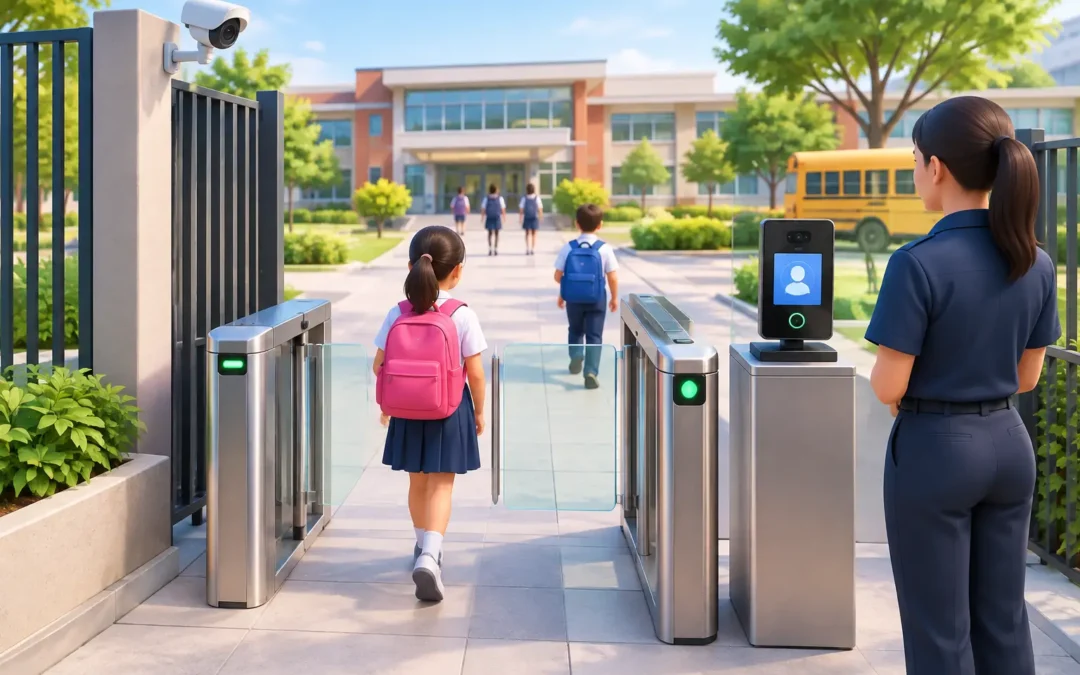
At 8.30 am, a school gate has to do more than mark a boundary. It must guide hundreds of students safely onto campus, give authorised staff clear control of entry, keep visitors accountable and still allow fast exit in an emergency. A well-planned school gate access control example shows how fencing, gates, latches, intercoms and site procedures work together rather than operating as separate items.
For Melbourne schools, the right arrangement depends on the campus layout, street frontage, student numbers, ute traffic and the way the grounds are used after hours. There is no single gate product that suits every school. A practical design starts with how people actually move through the site each day.
A school gate access control example in practice
Consider a primary school with a busy road frontage, a main pedestrian entry, a separate staff car park and sports grounds used by local clubs on weekends. The school wants a more controlled front entry without making morning drop-off feel slow or unwelcoming.
A suitable arrangement may include tubular fencing along the public boundary, with a wide double pedestrian gate at the main entrance. During supervised arrival and departure times, the gate is opened by staff to create a clear, visible entry point. Outside those periods, one leaf remains secured while a smaller pedestrian gate provides controlled access for approved visitors.
The visitor gate can be fitted with a commercial-grade self-closing mechanism, an electric strike or magnetic lock, and an intercom or video entry unit connected to reception. Visitors use the call point, identify themselves and are released by authorised staff. A clearly signed path then directs them to the school office, rather than allowing access through the grounds.
This example does not rely on electronics alone. The physical gate, fencing height, latch position, sightlines and closing hardware all matter. If a gate does not self-close reliably, or a person can easily step around the gate through a gap in the fence line, access control has already failed.
Start with movement, not hardware
Before selecting an access-control system, map the people and vehicles that use the site. Schools often have very different needs at different points of the day. Morning arrival may require wide, open pedestrian access under staff supervision, while the middle of the day calls for a locked perimeter and a controlled visitor entry.
Separate pedestrian and vehicle movements wherever the site allows. A pedestrian gate beside a vehicle sliding gate may look efficient on a plan, but it can create conflict if families, staff vehicles and service deliveries all arrive at the same time. Defined entry points, adequate gate widths and sensible paths reduce confusion at the gate line.
Visibility is equally important. Staff should be able to see who is approaching the entry, and visitors should be able to identify where to report. Tubular fencing is often a strong choice for front boundaries because it provides a secure physical barrier without blocking natural surveillance. Welded mesh can be effective around larger perimeters, courts and service areas where strength and coverage are priorities.
Choose gate types for the job they need to do
A school entrance commonly needs more than one gate type. The main pedestrian gate has different demands from a delivery gate or a sports-ground access gate.
Pedestrian gates should be sized for expected foot traffic, particularly where groups of students arrive together. A narrow single gate may be suitable for controlled visitor access but will quickly become a bottleneck at bell time. Double gates offer greater opening width when required, while a dedicated single-leaf gate can remain in use for day-to-day controlled entry.
Vehicle gates need appropriate clearance, safe operating space and hardware suited to their frequency of use. Sliding gates are often considered where swing-gate leaves would encroach on driveways or footpaths. Swing gates can be a practical option where there is sufficient room within the property line and a simple, durable setup is preferred.
For service access, the gate should be located so delivery vehicles do not need to cross busy student areas. If that cannot be avoided, the school may need scheduled delivery times and staff supervision as part of its operating procedure. Good fencing can support safe movement, but it cannot replace site management.
Use access control that staff can manage
The most advanced system is not always the best school system. If it is difficult to operate, staff may prop a gate open, share access credentials or bypass the process during a busy period. That defeats the purpose of the investment.
For a small campus, a self-closing pedestrian gate with a keyed lock, intercom and release from reception may be enough. Larger sites may require access cards, fobs, keypad codes or mobile credentials for staff and approved contractors. Automated gates may also be programmed around school hours, provided staff can override them safely when circumstances change.
A few questions help set the right level of control:
- Who needs access outside normal school hours?
- Can reception see or communicate with visitors at the gate?
- What happens when a gate loses power or a closer requires adjustment?
- How will emergency services enter, and how will occupants exit quickly?
- Which areas need public access for community sport or events?
The answer may be a layered arrangement: a secure school perimeter, a controlled front entry and separate access to facilities that can be hired after hours. This avoids opening the whole campus when only one court or oval is in use.
Plan for emergency egress and daily reliability
Security must not prevent people from leaving safely. Gate design, locking arrangements and access-control hardware should be considered alongside emergency procedures, fire safety requirements and the school’s own policies. The exact requirements can vary by site and project scope, so early coordination with the school, builder, consultant and relevant authorities is sensible.
Hardware selection also deserves attention. Hinges, closers, latches and locks are working parts. They need to suit gate weight, opening frequency, exposure to weather and the risk of misuse. A light residential closer on a high-traffic school gate is unlikely to provide dependable long-term performance.
Australian Standards compliance should be considered for the fencing and installation work, along with any applicable school, council or project specifications. On a live school site, installation planning matters as much as the finished gate. Work zones need to be controlled, pedestrian routes maintained where possible and the site left clean at the end of each day.
Common mistakes to avoid
One common mistake is installing a secure-looking gate without controlling the rest of the boundary. Gaps beneath fencing, low sections beside retaining walls, damaged mesh or unprotected side paths can create easier access points than the new gate itself.
Another is placing the visitor intercom too far from the office or in a position that cannot be easily monitored. A call point should support a prompt response. If visitors wait too long, they may follow another person through an open gate or seek another way around.
Schools can also overlook after-hours use. Sports clubs, cleaners and maintenance contractors may all need entry at different times. A separate, controlled access route can reduce the need to issue keys widely or leave a main gate unlocked.
Finally, avoid treating the installation as a set-and-forget project. Gates should be checked regularly for alignment, closing action, latch engagement and damage. A simple maintenance routine helps identify small problems before a gate stops closing properly during a busy school day.
A site-specific solution is worth the planning
The best school gate access control arrangement feels straightforward to students, staff and visitors because the difficult decisions were made during planning. It directs people where they need to go, keeps unauthorised access more difficult and gives staff practical control without turning the front gate into a daily obstacle.
With more than 40 years of fencing experience, Minster Fencing can assess school boundaries, pedestrian gates, vehicle gates and perimeter fencing across Melbourne and the Mornington Peninsula. A site inspection allows the team to consider access patterns, materials, gate hardware and installation requirements before providing an obligation-free quote.
A well-built gate is only one part of a safer school boundary, but when it is positioned properly, fitted with suitable hardware and supported by clear site procedures, it gives the whole campus a more dependable starting point each morning.