
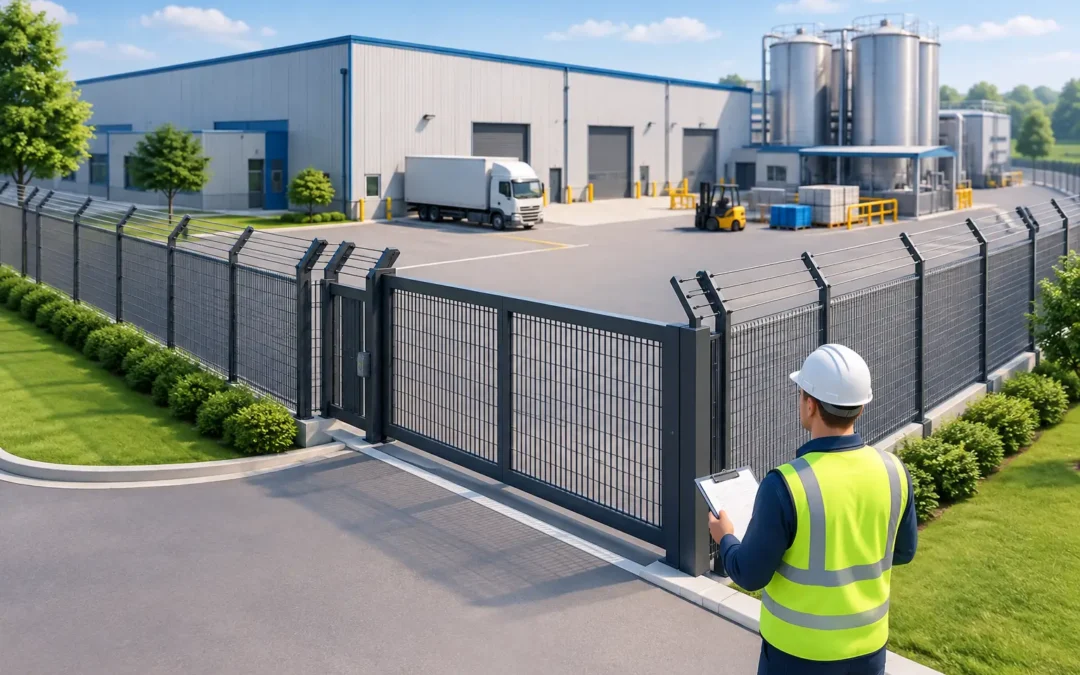
A fence around an industrial site has to do more than mark a boundary. It may need to control vehicle and pedestrian access, deter trespass, protect stock and equipment, separate hazardous areas, and stand up to constant use. This industrial site fencing compliance guide explains the practical checks that should happen before materials are ordered or posts go into the ground.
For Melbourne businesses, compliance is rarely a matter of choosing the tallest fence available. The right outcome depends on the site’s planning controls, its location, the activity being carried out, the security risk, underground services, gate movements and the people who use the site every day. Getting those details right early helps avoid costly changes once installation is under way.
Start with the site, not the fence
A compliant industrial perimeter begins with a clear brief. Consider what the fence is expected to protect and who needs legitimate access. A storage yard with high-value plant has different requirements from a warehouse boundary beside a public footpath. A manufacturing facility may need controlled pedestrian entry and separation around loading areas, while a depot may need wide gates that allow trucks to enter without blocking the road.
The fence line also matters. Confirm the legal boundary rather than relying on an old fence, informal markers or assumptions from a site plan. If a boundary is uncertain, engage a licensed surveyor before the work is set out. Moving a completed industrial fence because it crosses onto neighbouring land is an expense no project needs.
Check the ground conditions as well. Sloping ground, retaining walls, drainage swales, soft fill and existing concrete can all affect post depth, footing design and the final height of the fence. A neat, straight line on a drawing can require stepped panels, raked chain wire, custom fabricated sections or retaining work on site.
Check planning, building and local requirements
Industrial land does not automatically mean every fence design is permitted. Height, position, materials and visibility can be controlled by the relevant planning scheme, planning permit conditions, overlays, estate covenants or council requirements. Frontage fencing, fencing near intersections and fencing adjoining sensitive land often need particular care because sightlines and streetscape can be relevant.
A proposed gate also deserves early attention. Sliding or swinging gates must operate within the property where possible and cannot create a hazard for vehicles, cyclists or pedestrians using the road or footpath. If a truck needs to wait for a gate to open, make sure there is sufficient internal queuing space.
Building requirements can apply in some circumstances, particularly where fencing forms part of a larger development, supports other structures or is installed with retaining elements. A project team should confirm the approvals needed for its particular site rather than treating a standard fence detail as universal approval. For leased premises, check the lease and obtain landlord consent before making changes to a boundary or access point.
Select a system that suits the risk
Compliance and security work together, but they are not the same thing. A fence can meet a specified height yet still be poorly suited to the site if it is easy to climb, leaves gaps below the mesh, or has an unsecured gate beside it.
Chain-link fencing remains a practical choice for many industrial sites. It provides a clear boundary, good visibility and an economical solution for large perimeters. For higher-security applications, chain wire can be specified with heavier materials, closer mesh, angled extensions or other measures appropriate to the risk assessment.
Welded mesh and tubular fencing are often selected where a more rigid, harder-to-climb presentation is required. Palisade fencing can suit sites requiring a strong visual and physical deterrent. The trade-off is that higher-security systems generally cost more and need careful detailing around uneven ground, corners, gates and service penetrations.
Privacy may be useful where stock, plant or loading areas should not be visible from the street. However, solid or screened fencing can reduce passive surveillance and affect wind loading. It may also face different planning expectations than open mesh fencing. The best choice is usually a system that balances deterrence, visibility, appearance and the operational needs of the site.
Match materials and installation to Australian Standards
Relevant Australian Standards should inform both the materials selected and the way the fence is installed. The applicable standard depends on the fence type, intended use and associated works. For example, chain-link security fencing may be assessed against the relevant requirements for chain-link fabric, fencing and gates, while structural considerations such as wind exposure, footings and attachment details may require separate engineering input.
Temporary construction fencing is a different category from a permanent industrial boundary and should not be treated as an interchangeable product. Likewise, a light-duty pedestrian gate is not a substitute for an automated vehicle gate used dozens of times each day.
Ask the installer to explain what standard, specification or project documentation the proposed system is designed to meet. This keeps the conversation practical: fence height, wire or panel type, post spacing, footing size, coating, gate construction, locks and safety devices should all be recorded in the scope. A vague quote for supply and install fencing does not provide enough certainty for a compliance-sensitive project.
Design gates for safe daily use
Gates are often the hardest-working part of an industrial fence. They are also where security, safety and access can fail if the design is rushed. Start with the largest vehicle that routinely enters the site, then allow for turning paths, trailers, delivery movements and emergency access. A gate that technically fits a truck but requires a difficult manoeuvre will slow operations and increase the risk of damage.
Automated gates need particular attention. Depending on the equipment and site arrangement, the design may require safety edges, photoelectric beams, warning signage, emergency release, controls positioned away from moving parts and a planned maintenance regime. Pedestrian access should be separated from vehicle movements where reasonably practicable, rather than expecting staff and visitors to walk through a busy truck gate.
Hinges, rollers, tracks, guides and latches should be selected for the gate’s size and duty cycle. A heavy sliding gate on undersized hardware can become a safety issue long before it becomes a security issue. Drainage and surface levels around tracks are equally important, especially on sites where leaves, gravel or mud can build up.
Address safety beyond the perimeter
Industrial fencing can create hazards as well as control them. Review the proposed work through a workplace safety lens. Identify overhead powerlines, underground assets, forklift routes, loading zones, emergency exits and areas where staff need clear visibility. Before excavation, locate services and arrange the required checks. Never assume an existing service plan is complete or accurate.
Fencing near electrical infrastructure, rail corridors, waterways, road reserves or neighbouring operations may be subject to additional asset-owner requirements. Where a fence forms part of a restricted area, consider whether it needs warning signs, controlled access, anti-climb measures or a documented key and access-control process.
Fire and emergency planning should not be an afterthought. Gates and perimeter layouts need to support the site’s emergency procedures, including access for emergency services where required. A locked gate can be appropriate for security, provided authorised access arrangements are reliable and understood by the people responsible for the site.
Document the job and maintain the result
A well-installed fence will perform better when the site retains clear records. Keep the approved scope, drawings, product information, approvals, gate manuals, warranty details and any maintenance instructions. These documents help facilities teams manage repairs, verify what was installed and make informed decisions when the site changes.
After handover, inspect the perimeter regularly. Look for loose mesh, damaged panels, impact damage near loading areas, signs of corrosion, gaps under the fence, worn hinges and gates that no longer latch or close correctly. Prompt repairs matter. A small opening at the bottom of a fence or a gate left out of alignment can undermine an otherwise sound security system.
For larger or higher-risk sites, establish a simple inspection schedule and nominate who reports faults. It is more cost-effective to adjust a sagging gate or replace a damaged fitting early than to wait for a break-in, injury or operational disruption.
A practical pre-installation checklist
Before installation begins, make sure the project has addressed these five essentials:
- confirmed boundaries, levels, access points and underground services
- checked planning, landlord, council and project-specific approval requirements
- selected a fence and gate system suited to the site’s actual security and operational risk
- documented the required materials, finishes, footings, gate hardware and safety features
- planned safe installation access, ongoing maintenance and emergency entry arrangements
Every industrial site has its own pressures, from tight truck access in Melbourne’s south-east to exposed boundaries on the Mornington Peninsula. A site-specific inspection gives you a better result than choosing fencing from a standard schedule alone. With more than 40 years of practical experience, Minster Fencing can assess the boundary, access requirements and intended use before providing a clear, obligation-free quote for a fence built to serve the site properly.