
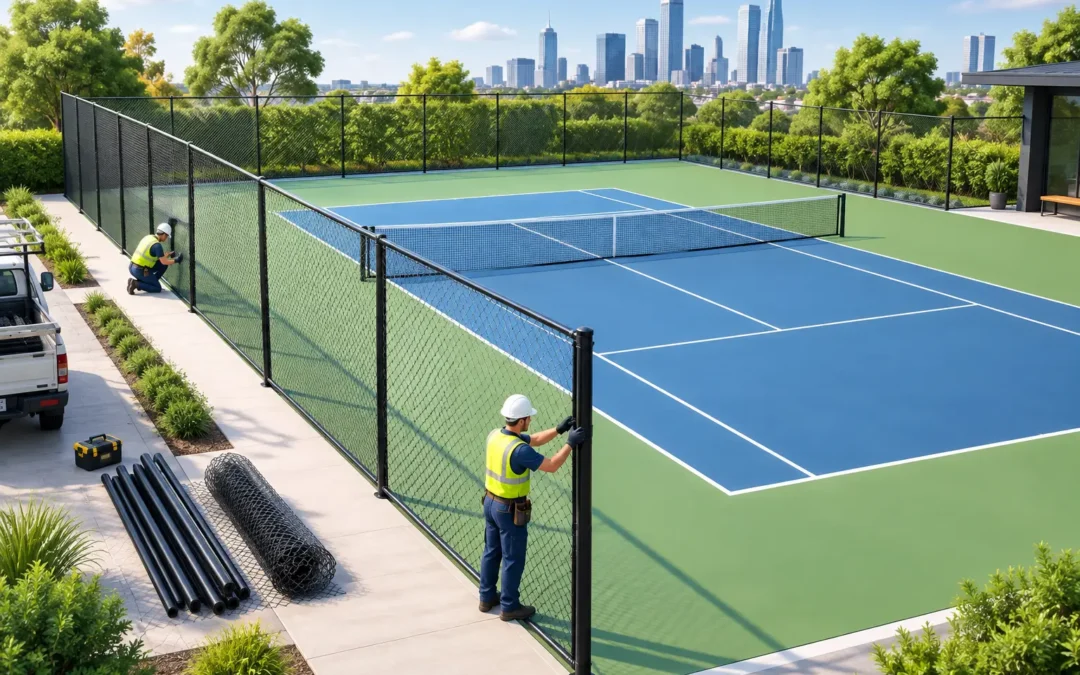
A tennis court can have a first-class surface and still be frustrating to use if balls regularly leave the playing area, gates rattle, or the perimeter starts leaning after a few seasons. Professional tennis court fencing installation Melbourne property owners and clubs can rely on starts with more than choosing a fence height. It requires a clear view of the site, the level of play, wind exposure, access requirements and the condition of the ground beneath the posts.
For homes, schools, clubs and public facilities, the right enclosure protects nearby property, keeps play moving and gives the court a finished, secure appearance. It also needs to stand up to Melbourne weather, regular impact and the practical demands of maintenance crews, coaches and players.
Start with the way the court will be used
There is no single fencing specification that suits every tennis court. A private backyard court may need a neat, practical enclosure that contains balls without overwhelming the surrounding garden. A school court often needs a tougher system that handles frequent use and controls access outside school hours. Clubs and shared sporting facilities may need greater height, stronger gates and consideration for adjoining courts, pedestrian areas or car parks.
The first decisions should be based on how the space operates. Consider who uses the court, whether it will host coaching or competition, how often equipment needs to enter, and whether the enclosure also forms part of a broader site boundary. These details affect the fence height, mesh type, gate arrangement and post design.
A court that backs onto homes or a busy road may benefit from additional ball containment. Where several courts sit side by side, internal dividing fences can improve safety and reduce interruptions between games. If the court is part of a school or community facility, access control can be just as important as ball retention.
Choosing the right fencing system
Chain-link fabric, commonly called chain wire, remains a proven choice for tennis court enclosures. It offers clear visibility, good airflow and reliable impact resistance when it is properly specified and tensioned. Galvanised or PVC-coated chain wire can be selected depending on the required finish, budget and exposure to weather.
Black or green PVC-coated chain wire is often chosen for courts because it visually recedes around the playing area and can complement the surrounding landscape. Galvanised chain wire has a practical, durable appearance and is well suited to many commercial and sporting applications. The better option depends on the setting and the finish expected across the site.
Welded mesh can also suit selected court applications, particularly where a more rigid, contemporary perimeter is required. It can provide a clean line and a high-security feel, although it is not always the most appropriate choice for every existing court or budget. The fence needs to work with the court, not simply look good in isolation.
Posts, rails and fittings matter as much as the mesh. A quality installation uses appropriately sized steel components, sound footing depths and properly tensioned fabric. Weak corner assemblies, undersized posts or poor tensioning can lead to sagging mesh, loose gates and a shorter service life.
Height and containment need to match the site
Fence height is one of the most visible decisions on a tennis court project. Lower perimeter fencing may be appropriate for a private court with generous space around it, while taller fencing is often needed behind baselines or around high-use club courts. The aim is to reduce lost balls without creating an enclosure that feels excessive for the location.
It depends on the court layout. A ball hit long behind a baseline needs more containment than one travelling toward an open side setback. Nearby buildings, roads, footpaths and neighbouring properties should all be considered before finalising heights. A site inspection helps identify where standard-height fencing is suitable and where extra protection is sensible.
Ground conditions shape the installation
Melbourne sites can vary widely, even within the same suburb. Existing concrete, compacted fill, clay, tree roots, sloping ground and underground services can all affect post placement and footing work. On an older court, previous fence footings and damaged edges may need attention before a new enclosure is installed.
A professional contractor will assess the perimeter rather than assume every post can be installed at the same depth with the same footing. Posts must be positioned accurately to maintain straight fence lines, correct tension and reliable gate operation. Where levels change, the fencing approach needs to keep the enclosure secure while working neatly with the fall of the land.
Drainage is another practical consideration. Water sitting around the perimeter can affect both the court edge and the ground supporting the fence. If water regularly moves across the site, it is worth addressing the cause before installation rather than expecting the fence to solve a drainage problem.
Gates should make access easy and secure
Gates are often treated as a minor detail, but they are one of the hardest-working parts of a tennis court enclosure. Players need a gate that opens smoothly, closes properly and does not become a trip hazard. Grounds staff may need wider access for maintenance equipment, court resurfacing or deliveries.
A pedestrian gate may be enough for a private court, while a club or school may require a wider double gate for machinery access. Gate location should suit the path people naturally take to the court and avoid conflict with player movement, nearby parking or emergency access.
Latches, hinges and closing arrangements should be selected for the expected level of use. A lockable gate can help manage access when the court is unattended. On shared sites, the right gate arrangement reduces the temptation for users to climb the fence, which protects both the enclosure and the people using it.
Compliance is part of good planning
Tennis court fencing may need to meet relevant Australian Standards, planning conditions, school requirements, club specifications or site-specific safety obligations. Requirements can differ depending on the property type, fence height, location and whether the court is private, commercial or part of an education facility.
This is why an installation should not be based solely on a quick measurement or a low-cost quote. A contractor needs to understand the intended application and identify practical compliance considerations before work begins. For builders and facilities managers, clear scope, material specifications and installation details also make coordination with other trades far easier.
If the fencing forms part of a security perimeter, the discussion may extend beyond the court itself. Tubular fencing, welded mesh, access gates, bollards or adjoining boundary fencing can be integrated where the site needs a more complete solution.
What a well-managed installation looks like
A dependable fencing project begins with a site-specific quote. The scope should address the fencing type, heights, gate locations, access constraints, ground conditions and any removal of existing materials. This gives the owner or project manager a clearer basis for comparing options and avoiding surprises once work is underway.
During installation, accurate set-out is essential. Posts are installed and aligned before rails and mesh are fitted, then chain wire is tensioned to create a firm, even finish. Gates are adjusted so they swing and latch correctly. A tidy contractor will also manage offcuts, packaging and removed fencing responsibly, leaving the court perimeter ready for use.
Timing can depend on weather, site access, concrete curing and coordination with surfacing contractors. If a court is being resurfaced or built from new, fencing should be scheduled at the right stage so trades are not working around one another unnecessarily. Planning this sequence early is usually simpler and more cost-effective than changing finished work later.
Why experience matters on sporting fences
Sporting-ground fencing is specialised work. It must absorb repeated ball impact, remain taut across long runs and cope with regular gate use without becoming loose or misaligned. It also has to look professional, particularly for schools, clubs and commercial venues where the court is part of the public face of the property.
Minster Fencing brings more than 40 years of fencing experience and four generations of family trade knowledge to projects across Melbourne Metro, the Mornington Peninsula and South Eastern Melbourne. Our team can assess the site, recommend a practical court enclosure and complete the work with materials and installation methods suited to the job.
A well-built tennis court fence should quietly do its job for years: contain the ball, protect the surrounding area and keep the court accessible when it is needed. For a site-specific, obligation-free quote, speak with a fencing team that will assess the whole court perimeter before recommending the right way forward.